Think choosing new equipment is about finding the right price? Think again, says A1 ADAS’ garage equipment specialist Ant Yates.
Every day, technicians identify worn tyres, uneven wear patterns and balancing issues during servicing and inspection work. Yet many garages send that work elsewhere because they either don’t have tyre changing equipment, or the equipment they do have no longer reflects the vehicles coming through the door. For any workshop carrying out servicing, that raises an obvious question: how much potential revenue is being left on the table?
Garages without the equipment they need are often left with two choices: point the customer towards another business or send a technician out with the wheels and tyres and hope there is still enough margin left in the job to make it worthwhile.
“It’s always about balancing cost and performance,” said Ant Yates, who has more than a decade of experience advising garages on tyre equipment and workshop investment decisions. “But before you spend any money, you need to know what you’re buying, why you’re buying it and whether it’s right for the work coming through your doors.”
“If you’re upgrading, why are you upgrading? Are the wheels getting bigger? Are you getting busier? Is your current equipment struggling to keep up, or not capable of dealing with more modern vehicles? If you don’t have tyre equipment at all, then the question is different. How much work are you currently sending away, and what could that be costing you?”
“If you send a customer down the road for tyres, you’re potentially sending them to another business that may also offer servicing, MOTs and repairs. Customers are busy. If they realise they can get everything done in one place, there’s always a chance they won’t come back.”
Outsourcing time and profit?
Outsourcing tyre work can also drain time from the workshop. If a technician takes wheels out to a third party, waits while the work is completed or makes a second trip to collect them, they’re out of the workshop instead of working on something productive.
“When you take an aerial view, tyre equipment is not just about making a margin on a tyre,” Ant continued. “It’s about keeping the customer, keeping the work in-house and keeping technicians doing profitable jobs rather than driving around.”
The trap for many garages is assuming the right equipment is simply the cheapest machine that will get them started.
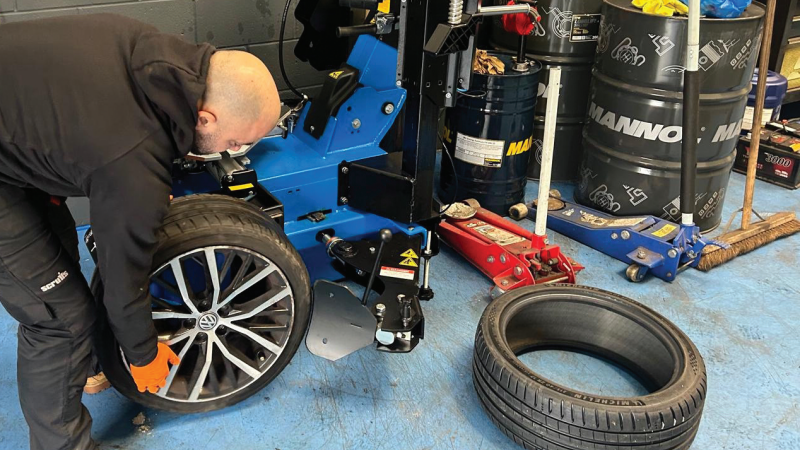
“A garage might say, ‘We only do five tyres a week, and that’s fine,'” he said. “But if two of those are run-flats and another couple are low-profile tyres on larger wheels, the cheapest machine may not be able to do the job. At that point, you’ve bought equipment, and you’re still sending work away.”
“Make a tally. Look at the wheel sizes in the workshop right now. Check the tyre sizes from the last few months via the automatic VRM lookup on your garage management system or on job cards. If nothing is bigger than 22 inches, that tells you one thing. If you’re regularly seeing 23 or 24-inch wheels on executive cars, that tells you something very different.”
Let reality dictate choice
That real-world evidence gives the workshop a much stronger starting point and prevents the business from buying either too little or too much machine for the work it needs to handle.
“It’s not about pushing everyone towards the most expensive option,” said Ant. “If you only do one or two tyres a week and the machine is capable of doing those tyres properly, a more cost-effective option may get you a faster return. But if you buy cheap and it can’t do the job, or it keeps breaking because you’re putting too much work through it, it stops being cheap very quickly.
“I’ll usually quote three options. I might suggest the middle one is the best fit, but I’ll still show the customer what they lose by going down a level and what they gain by going up. Then they can make the decision properly, rather than just comparing prices without knowing what sits behind them.”
Those differences might include clamping capability, assist arms, leverless functions, bead breaker design, balancer accuracy, laser positioning, sonar measurement or the level of warranty and backup included.
Technology within tyre equipment hasn’t changed as dramatically as some other workshop equipment, but useful features have become more accessible. Leverless heads and assist arms help with stiffer, lower-profile tyres, while wheel balancers with laser guidance and sonar measurement can improve speed and reduce human error.
“A lot of the improvements are about making the job quicker and more accurate,” said Ant. “Features that were once mainly on premium machines are now filtering into more cost-effective equipment, which is good news for garages.”
Wheel alignment next?
With tyre changing and balancing equipment in place, the natural next step to consider is wheel alignment, provided there’s ramp capacity to support it.
“It all goes hand in hand,” Ant said, “If you’re doing a service and spot uneven tyre wear, that indicates the vehicle needs a wheel alignment check. If you’re already fitting tyres, you could then offer alignment as part of the conversation you’re going to have with the customer. Every alignment job then quickly chips away at the initial equipment cost until it becomes self-sufficient and an additional profitable revenue stream for the garage.
“To make that happen, the tyre fitter or technician doing the service has to diligently flag uneven wear. Then, crucially, the front-of-house team must be properly trained in how to explain it to the customer in a way they understand.
“It’s not just a money-making exercise. It’s about explaining why the work is safety critical and your professional duty to help them keep their vehicle and its occupants as safe as possible.
“Poor alignment can shorten tyre life, affect handling and increase stopping distances. Helping customers understand those issues is often what turns a tyre fitting job into a wider wheel and tyre service offering.”
Workshops don’t invest in tyre equipment very often, which is why taking the time to understand the requirement is so important. Garages seeing the strongest returns are rarely those that simply bought the cheapest or most expensive machine. More often, they’re the businesses that understood their workload, bought equipment that matched it, and made tyre safety part of the customer conversation.