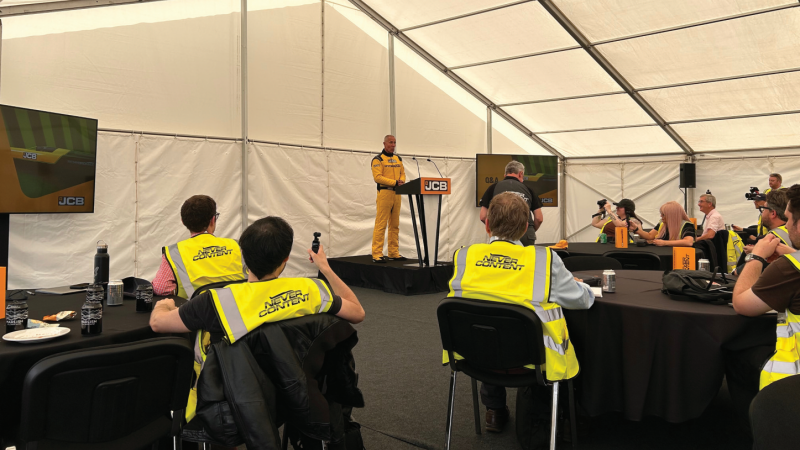
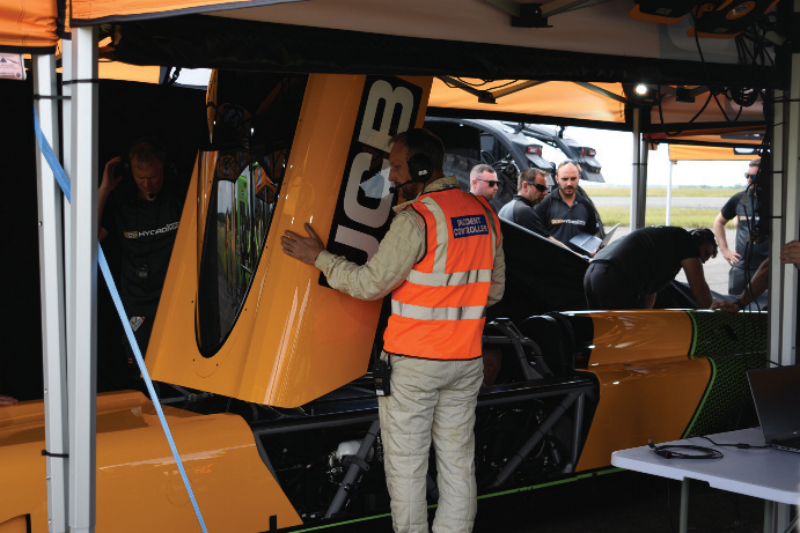
PMM editor Kieran Nee was invited recently to observe testing of JCB’s Hydromax vehicle designed to break the land speed record for alternative fuels and it got him thinking, could hydrogen technology jump across from industry to passenger transport?

It’s not something which features often in the pages of PMM, but if JCB’s recent forays into the technology are anything to go by, the thing that Elon Musk called “the most dumb thing I could possibly imagine for energy storage,” might well be appearing more frequently. I am talking, of course, about hydrogen.
Before delving into the technology itself and the pros and cons of using it to power passenger cars, let’s address the elephant in the room: What the hell is JCB doing in Professional Motor Mechanic magazine? Well, to answer that, it must be explained that besides its output in backhoe loaders and its leader Anthony Bamford’s outspoken comments on Brexit, JCB is also a big player in engines for off-highway equipment.
To demonstrate the efficacy of its diesel engine, in 2006 the firm built a highspeed aerodynamic car powered by two JCB diesel engines, providing 750 bhp each and each accompanied by a turbocharger. With Andy Green at the helm—the driver who held and still holds the overall land speed record—Dieselmax broke the diesel-powered land speed record at the Bonneville Salt Flats in Utah, reaching 350 mph. This is some way off the 763 mph Andy reached with the sound-barrier breaking, jet-powered Thrust SSC car in 1997, but still fast enough to get you from Land’s End to John O’Groats in less than 2.5 hours, or from Harrogate to York in 3 minutes, 40 seconds.
Replicating the magic
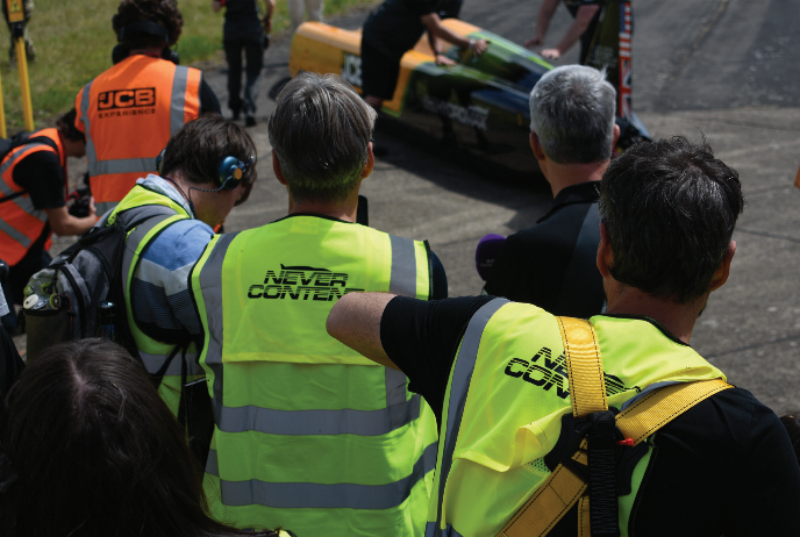
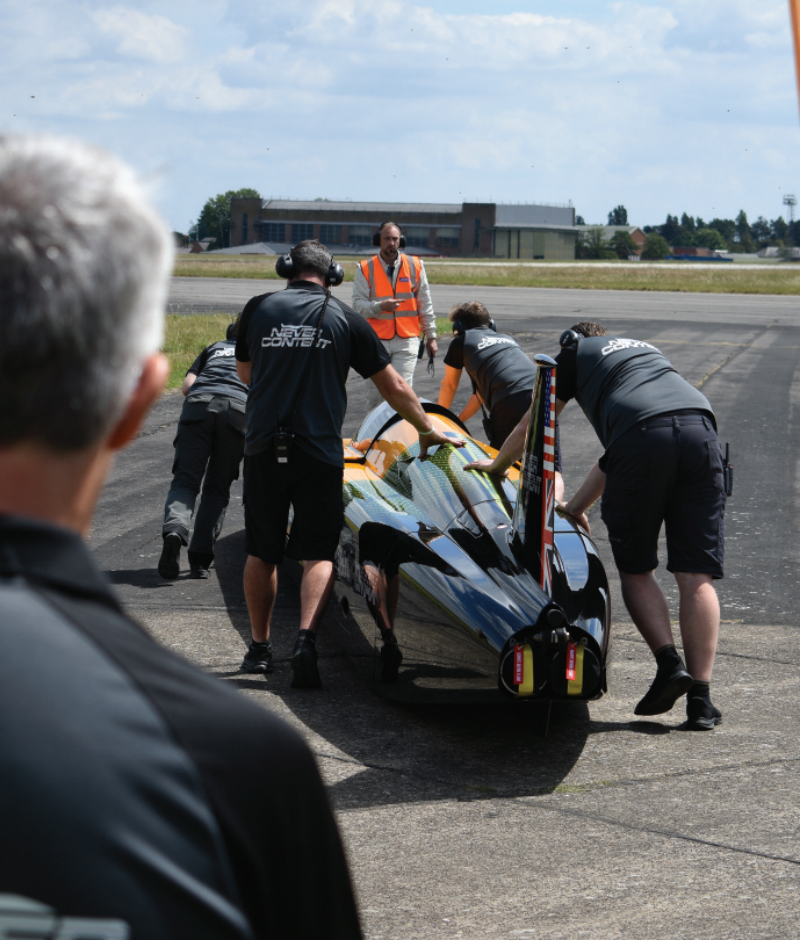
Displaying an uncanny nous for capturing the moment, upon noticing that the 20-year anniversary was fast approaching, Mr Bamford declared that he wanted to repeat and even surpass the previous record. Only this time, they would use their latest engine—the Hydromax—and prove once and for all that hydrogen is a feasible alternative to traditional fuel. And what’s more, Andy Green, the man, the legend, would be back to do it.

So that’s what JCB have got to do with it all. But what about hydrogen itself?
For a long time now, advancements in vehicle production have centred around reducing local emissions. Petrol and diesel engines have incorporated a number of new technologies to drive efficiencies and reduce tailpipe emissions with great success, it must be said, even if some of the improvements have resulted in much disgruntlement from drivers and garages alike (we’re looking at you, belt-in-oil).
Zero emissions
But that wasn’t ambitious enough according to Governments and policymakers around the world. Why limit ourselves to reducing local emissions when the technology exists to eliminate them completely? Step forward the previously mentioned Mr Musk, who, politics and personality aside, has done more to shake up the automotive industry than anyone else in the past 30 years. His solution, which was a pipe dream 20 years ago, was the battery-powered electric vehicle. For years, Tesla held the top spot for sales in EVs. Still today Tesla is a by-word for EVs (and, confusingly, autonomous cars).
As the quote from Musk above indicates, his view is that electric is the only way forward in the fight against emissions. That is a view largely shared by politicians who had mandated that the sale of combustion engines specifically is to be proscribed from 2030 on in the UK, and severely curtailed from 2035 in the EU. This will put the UK at the forefront of the global fight against carbon emissions.
But is it the only way, or even the smartest way to achieve that goal?
Many commentators in the industry, including the recently retired technical director of the IAAF, Neil Pattemore, have argued that the UK should be less proscriptive in its decrees. The argument is that instead of banning combustion engines, the Government should require zero emissions vehicles. How vehicle manufacturers get to that point is up to them.
I’m not going to get into the endless morass of pro and anti EV arguments. This is not an article about electric vehicles and batteries, but rather about hydrogen and whether there is any potential future in using it to power passenger vehicles.
Path to hydrogen
Many of you reading this might assume that JCB is hardly coming from a neutral standpoint on the issue. After all, combustion engines are their bread and butter and, given the general political outline that the EV vs. ICE debate has taken, the overtly right-wing Anthony Bamford was never going to be an EV fan. Well, the truth is that JCB introduced the first electric powered mini-diggers to the market (and have kept selling them) and their road to hydrogen developed out of the limitations of electricity.
Engineering director at JCB, Ryan Ballard, told the assembled journalists at RAF Wittering (where the Hydromax testing was taking place), how the firm came to hydrogen in the first place. JCB owns four quarries and were looking to electrify all the machines on one of them, necessitating a connection to the grid. Being a quarry, it was far away from the closest grid connection and was going to cost £13 million to lay the power lines over the 13km distance. Driving back and forth to the power station with a huge battery pack was also unfeasible and way too costly.
That’s when they started thinking seriously about hydrogen. “We need a mobile fuel for remote areas, we need fast refueling for maximum uptime,” Ryan explained. Bio-fuels were considered first: “The lorries that say they’re powered by chip fat? That’s Biodiesel, B100, they’re using,” the engineering director told us. “The problem is that it’s not all coming from the local chippy, but rather from forests being cut down for palm oil.”
Relying on the power of the natural world—wind, solar etc—was also impractical. How do you transport around a solar farm from construction site to construction site? How do you store so much energy over time?

So, onto hydrogen. Hydrogen comes in two technological guises: Fuel cell technology and combustion.
Fuel cell technology is similar to an EV. In place of a battery, fuel cells are used which convert hydrogen and oxygen into electricity, heat and water vapour. The problem JCB faced, is that these fuel cells aren’t well suited to sudden shifts in power demand such as an excavator breaking ground for instance.
Just make an engine!
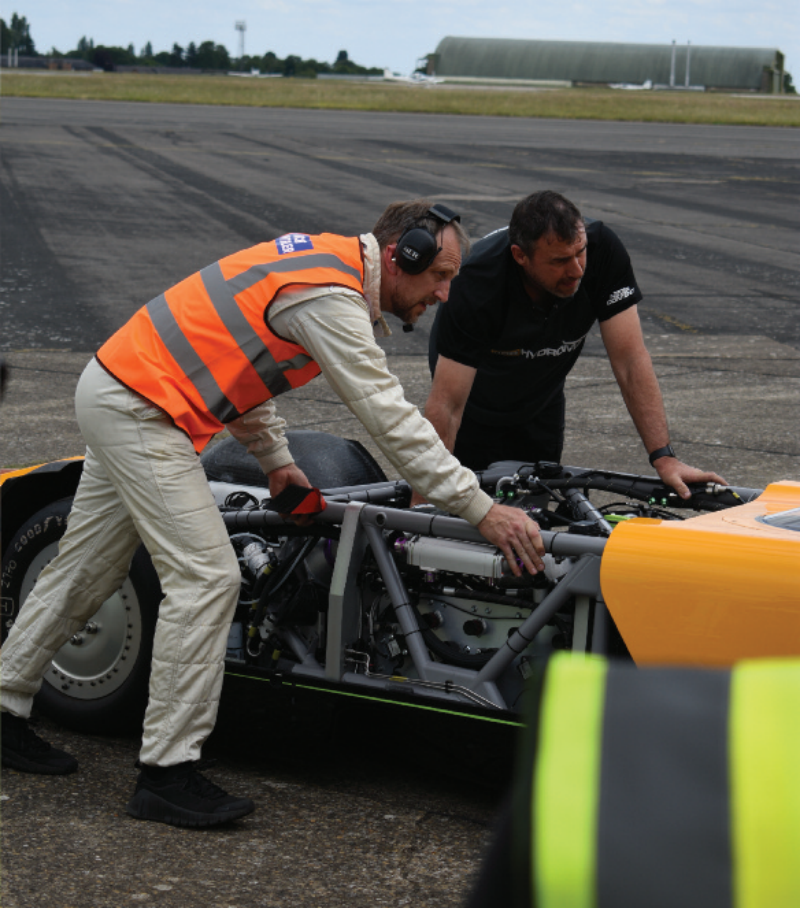
Here, again, was where Mr Bamford’s knack for simplicity and efficacy cut through the noise: Why don’t we just make an engine, he asked his engineers.
“We researched it, and everything we read told us not to do it,” Ryan admits. “The two things we wanted was firstly, you put hydrogen in and get nothing but water out, and secondly, it had to match the performance of existing technology. Over the course of the five years we’ve been working on this, the engines have been used, maintained and serviced all over the world, with user experience matching diesel completely.”
JCB has a hydrogen-powered excavator in production, available to buy today. The International Energy Agency has said that hydrogen is “one of the leading options for storing energy from renewables and looks promising to be a lowest-cost option for storing electricity over days, weeks or even months.”
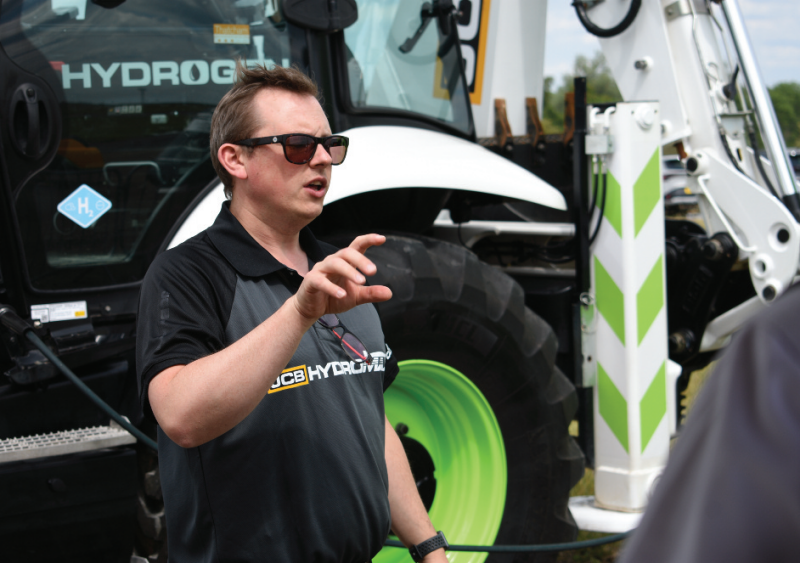
Storing hydrogen is cited as one major pitfall. Musk claimed “gigantic tanks” would be required to hold it in liquid form and “even bigger” in gas form. The compressed gas tanks the JCB digger uses fit neatly above the cab. Some estimates say the digger can go a week before being refilled.
None of this addresses the production of hydrogen, which after all might be the real issue. Producing enough for a few hundred diggers is one thing, but to power every car in the country? That’s quite another. And I’m sure there are lots of issues with hydrogen which people far smarter than me are aware of—nothing is ever quite so simple as it seems. But I think the point is not that it is the one solution to the carbon crisis, but that it might be worth exploring alongside EV technology. EVs have come on in leaps and bounds in recent years but still present huge barriers to usage for lots of people. Whilst hydrogen might not be feasible as things currently stand, are we really saying that the situation can’t change?
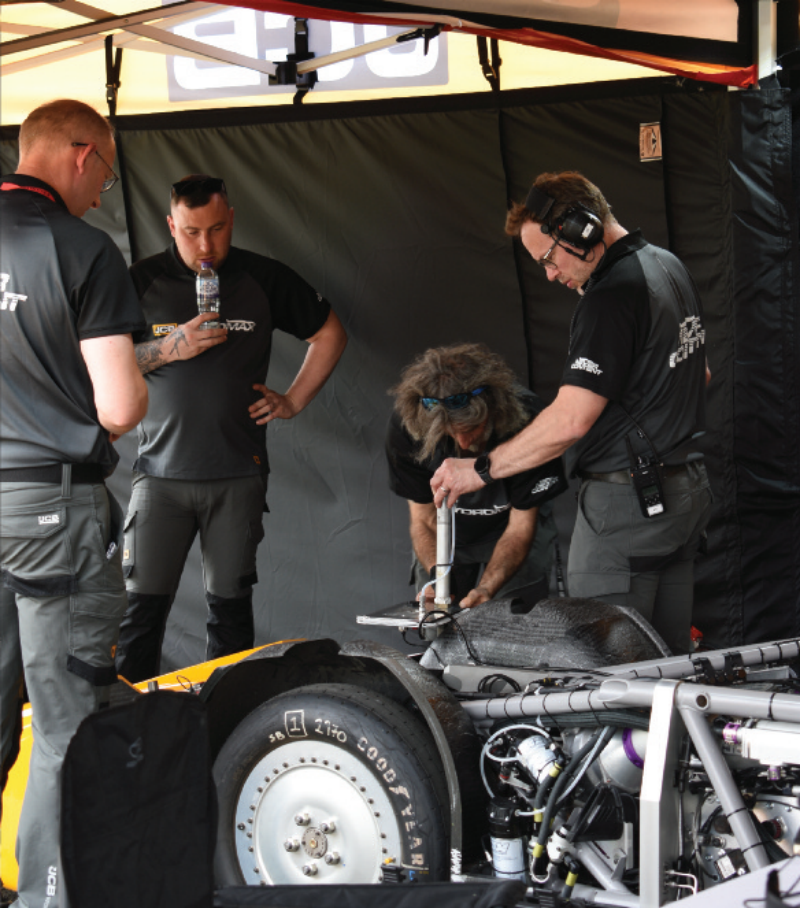
Scientists and engineers have achieved more miraculous things in the past century, after all. As you are reading this, it could well be that JCB have broken their diesel speed record with Hydrogen and that alone should make people take notice.