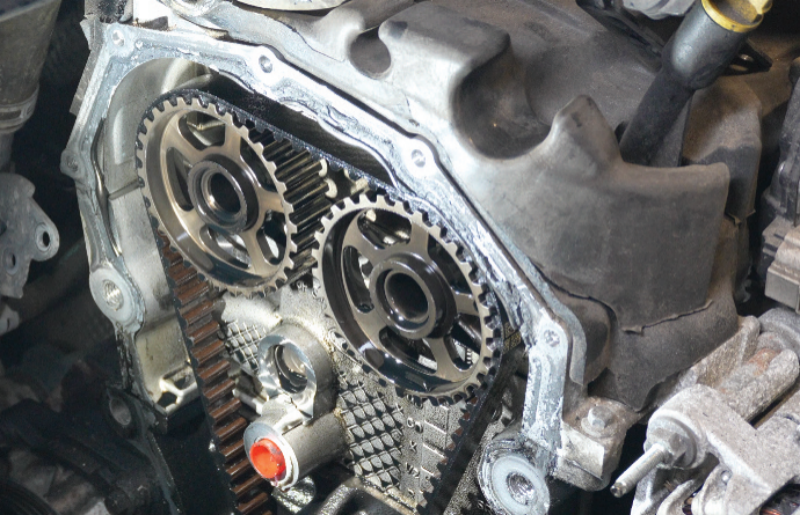
Dayco is spreading the message: Wet belts are here to stay and you should seize the opportunity.
The weight saving, friction reducing and stretch resistance properties that a flexible belt running within a bath of oil provides, have delivered a solution that has helped vehicle manufacturers to be able to design and produce much smaller capacity engines that are still able to deliver the power and performance they require, while also allowing them to comply with global emissions reduction targets.
The wet belt is, therefore, a component that is here to stay and workshops and technicians need to understand that its ongoing maintenance and periodic replacement are opportunities they should embrace.
Failure to maintain
Stating the obvious, and in common with an external primary drive belt, as well as an internal chain, wet timing belt failure will have catastrophic consequences for an interference engine and result in a large repair bill for the owner.
So, the first opportunity that a vehicle with a wet belt affords the workshop is the chance to engage with the customer and to understand how, and how often, they use their car and also to emphasise the importance of following the VMs scheduled service intervals, as prevention is considerably better than cure.
This is particularly important because looking at the reality behind the negativity that is often associated with wet timing belt failure, two factors generally come to light: The condition of the engine oil and regularity of the servicing.
This brings the focus back to developing a relationship with the customer and understanding how their car is used. For someone who uses the vehicle regularly and for journeys that allow the engine to fully warm up and operate at its ‘normal’ operating temperature for reasonable periods, for example, then the primary message is to ensure they strictly adhere to the VM’s service and replacement intervals and not be tempted to delay them.
However, for a customer who uses the car infrequently and for very short journeys, in addition to following the annual stipulations of the VM’s service and replacement schedule, the condition of the oil, most notably from potential fuel contamination, must be regularly assessed.
Driven by the car makers
Dayco is the original equipment supplier of the wet belt solution for several engines for a number of VMs, including Ford, Stellantis and VAG, so is therefore in the ideal position to comment on the most common causes of belt failure.
Technical account manager, Glen Goldstone, takes up the story: “Although it’s no longer an unusual component for them to come across, some technicians still question the validity of a wet belt compared to a chain. So, it’s worth pointing out that despite Dayco being the specialist supplier that found the solution, it was the VMs that inspired the concept, and it was to their design specifications that it was successfully developed.
“Statistically, owners who rigidly follow the VM’s service and replacement intervals, rarely have issues with the wet belt in their vehicle. However, ignoring either the specified mileage or timeframe hugely increases the potential of a belt failure.
“In addition, other mitigating factors, such as a higher degree of contamination in the oil than originally anticipated in the VM’s design specifications, can reduce the lifespan of the belt, in extreme instances to less than the specified service interval.
“This threat, therefore, requires workshops to be more proactive with these vehicles than with others, and to check for the presence of fuel or debris in the oil, when the vehicle is in for a routine oil and filter change, for example.
“Due to the fact there are now many engines that use wet belt technology, which include Ford’s EcoBoost and EcoBlue, PSA’s 1.2-litre PureTech and VAG’s 1.6 TDI, there are clearly a lot of vehicles that are likely to visit the independent workshop, and at some point they will require a wet belt change.
“The introduction of wet belt technology therefore provides an obvious long term revenue stream for independents, which can only be good for the profitability of their businesses, irrespective of the personal opinions of the technicians that are undertaking the work.”