
PMM editor Kieran Nee spoke to ZF Aftermarket’s head of global remanufacturing Tomasz Galazka to find out more about remanufacturing in 2026 and beyond.
Hi Tomasz, thanks for speaking with me today. FAAS research shows that when offering remanufactured parts to customers, workshops aren’t necessarily promoting the CO₂ savings behind such a product – why do you think that is?
82 per cent of workshops believe in the sustainability of remanufacturing, but only 39 per cent of them are highlighting it to the customer. There is an interesting situation in France, where legally workshops have to offer a sustainable solution, which naturally is the remanufactured product. I can also see in the same FAAS report that around 21 per cent of workshops would like more data on the CO₂ savings of reman products. So that’s on us, the manufacturers, to provide that additional information and close that gap.
If garages knew more about the sustainability of remanufacturing, would they pass that information on to customers?
In my opinion, they would and they definitely should because it’s an important aspect.
Still from the same survey, garages said that price was far and away the primary reason for choosing reman parts (88 per cent), do you think garages would be less likely to opt for reman if the price difference wasn’t so attractive?
I think price is important, but it’s not the only factor in making the decision. Let’s imagine you take the cheapest product, it might fail after one month and then you are in a difficult situation. To make a proper decision, normally the workshops and customers need to consider other factors, like who is the supplier, is it a trusted supplier, is the part available? In my opinion, reman is a smart decision because at the end you get a product with the same functional performance as the OE option, with the same warranty.
Reliability issues around sourcing reman parts is a problem for many garages. What can remanufacturers like yourselves do to improve that?
It’s mainly because of the cores, the used product which in our world we call “core”. We take the cores from the market and then transform them into the remanufactured product. We see two issues on the market. First of all is the quality of the cores.
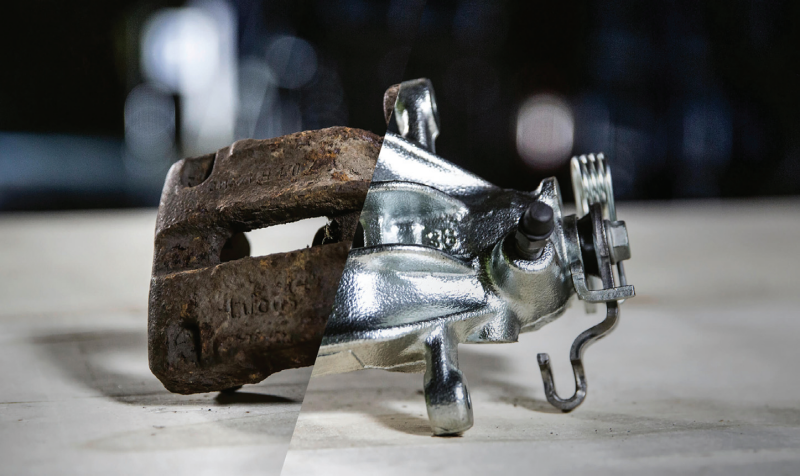
Sometimes, if we get the core and the core is not good quality, then we can’t produce a product out of it. We don’t accept heavy rust or a broken body, for example. So this is the first aspect. The second aspect is that we don’t always have a 100 per cent return rate of cores. Sometimes we need to scratch our heads and think how to bring the product back from the market. For this we established the CorExpedia application. This is an IT tool, which helps to collect cores for us and for our distributors.
Our distributors can also name a workshop where we can pick up the cores and deliver to our clients. Inside this application, we normally put all of the documentation, core acceptance criteria and all of the aspects necessary to handle good core. Normally, we take all burden on our side, which means if you show us a pick-up address, wherever it is in Europe, we as ZF will pick it up.
Tomasz, since we first agreed to do this interview we have seen a lot happening on the world stage. In a more general sense, the 21st Century is shaping up to be one of disruption to global supply chains rather than consolidation. All this to ask, is it going to harder to produce OE parts going forward, with their high energy and raw materials costs?
Yes, we have already had a couple of crises come up. For the past few years we’ve been living through the crisis which started with COVID. Then there was the Suez Channel blockage, now new disruptions. Every time I see times of crisis I see remanufacturing become more and more popular. Indeed, as you say, OE factories could have potential issues.
Where does the UK stand in terms of uptake for remanufactured parts with respect to the rest of Europe? Does being an island post-brexit hinder the supply of core?
The UK is one of the top three markets for our reman products – it is a very important market for us. When Brexit started, we scratched our heads about what to do because it put some burden on our customers, especially with the import-export documentation. So we set up a collection point in the UK where we bring all of the cores from our customers. A UK customer doesn’t feel the impact of Brexit, we take the burden.
Are garages buying more remanufactured parts now than, say, 10 years ago?
The rise of remanufactured parts has gone hand-in-hand with the decline of repair kits. More and more, European workshops have prioritised efficiency and speed rather than cost, and so have turned to wholesale replacement rather than repairing parts themselves. What you can also see, is that in different parts of the world, such as Brazil, China and India, where labour is still very cheap, repair kits remain the popular choice instead.
Thinking about the future, however, there is a front wind. Low quality parts coming from outside Europe are a threat to the industry and a problem for remanufacturing as their specification is unknown. Hence, they end up in landfill.
Editor’s Note : Editor’s note: Well-known UK remanufacturer Shaftec recently went into administration, citing low quality parts imported from the East as a direct cause of their inability to continue trading after 30 years.