
Denso’s A/C product specialist Richard Groot takes a look at the state of the A/C repair sector and why workshops aren’t more clued up when it comes to air con.
Despite the fact that air conditioning and climate control systems have been a standard feature on the typical car for a number of years, why does A/C service still present such a challenge for mainstream workshops?
Although technicians generally have a sound knowledge of how most vehicle systems – engine, exhaust, thermal (cooling), ignition, transmission, chassis etc. – actually function, the majority don’t have the same level of understanding of the A/C system, which is the fundamental problem. This lack of knowledge of the basic operating theory means that, in a typical independent workshop anywhere in Europe, A/C service is not carried out to the quality that it should be, and why specialist A/C businesses have thrived.
This is a crazy situation for motorists, who should have confidence that the workshops they use can competently undertake all type of service and repair work on their vehicles, but also means that most workshops are losing out on much needed revenue.
Transferring heat
Every A/C system, whether in a traditional combustion engine-powered vehicle, a hybrid or a full electric vehicle, operates on the same principle, that is to take heat from point A (generally inside the passenger compartment), and transfer it to point B (outside the vehicle). However, because they don’t have a combustion engine from which to harvest heat, many electric vehicles use a heat pump system, which can also reverse the cycle when the weather is cooler and take heat from the outside and use it to warm up the passenger compartment, as well as being able to cool it when the outside temperature is high.
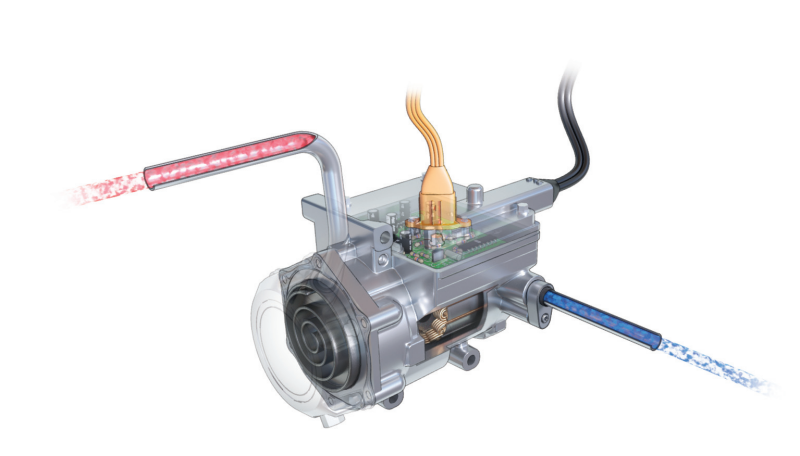
However, while the system is very efficient at using only a small amount of power to warm the passenger compartment, its heating performance is significantly reduced at low ambient temperatures, because it is difficult to collect heat from outside in these conditions. To combat this problem, some hybrid vehicles, such as the Toyota PRIUS PHV, are equipped with an electric compressor, which has a gas injection function that assists heating by returning a portion of the heat-dissipated refrigerant, back to the heat pump system.
Lack of understanding
Irrespective of whether it’s a traditional or heat pump system, this widespread lack of understanding of how the A/C system works means that mistakes in diagnosis and repair are often made, and sadly, the typical workshop’s response to A/C service is to just re-gas the system, which, without understanding the basics, can often cause more problems than it solves and certainly cannot be described as A/C service!
It is also worth mentioning that the situation can be made even worse if, in addition to not understanding the A/C system, technicians also don’t understand how an A/C refilling machine operates and what it does, and just hope that using it will automatically service the system.
Fundamentally, if they don’t understand the A/C system, they won’t be able to diagnose problems with the refrigerant cycle and the component that’s in the frontline when it comes to the consequences of the most common errors, is the compressor. This is because it does the hard work of pushing the oil/refrigerant mixture around the system and if there is the slightest problem with the ratio of the mixture or it is contaminated with dirt, or debris from a worn part, the compressor will take the brunt, so is the unit most likely to fail.
Finding the root cause
However, going back to the lack of A/C knowledge in the industry, although it’s the compressor that is likely to fail, it’s rarely the compressor itself that’s at fault, it’s another underlying issue that needs to be resolved before the compressor is replaced, otherwise a new compressor will simply fail again.
So, referring to the A/C refilling machine, if you do not understand what the machine is doing during an A/C service, especially if it is a fully automatic machine, things can go wrong. For example, it’s easy to add too much oil or too much UV-Dye to the system, because the machine is on the wrong setting. It’s also possible to introduce the incorrect amount of refrigerant because of an uncalibrated scale on the internal tank.
Trial and error
As a result of all these factors, A/C system repair can sometimes become a case of trial and error, instead of real fault finding. As technicians struggle to understand the refrigerant cycle, in many cases their diagnosis is only based on checking the system’s pressure, but as many vehicles now use electronic controlled, variable displacement compressors, it is also important to check the system’s temperatures and live data, for example. Not following the installation instructions when replacing a compressor is another major problem, which can result in a further failure and expensive (warranty) repairs.
So, what options do workshops have to turn these issues into revenue streams?
Across Europe, Denso offers training covering everything from the basic steps of A/C service, through to the analysis of compressor failure, which can be accessed through its distribution partners, viewed on YouTube videos or via the online e-Learning training platform.
Equipped with this knowledge, technicians undertaking the work are able to tackle A/C service and repair with confidence, which also means that workshops will benefit from extra revenue opportunities and offer a right, first time level of service to their customers.