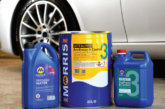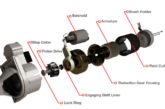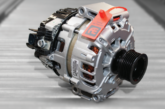
As A/C compressors become more complicated, the oil you choose when servicing increases in importance. Mahle explains.
Lubricants are fundamental to the reliability and efficiency of modern vehicle systems, yet they are often overlooked during service and repair. Nowhere is this more evident than in air conditioning systems, where compressor oil plays a critical role in protecting components, maintaining performance and ensuring long-term durability.
Just like engine oil, air conditioning compressor oil lubricates moving parts, reduces friction and heat, and helps seal internal components. If the wrong oil is used, or if poor-quality lubricants are introduced, the result can be increased wear, reduced system performance and ultimately premature compressor failure.
With multiple refrigerants and compressor designs now on the market, selecting the correct lubricant has become increasingly important for workshops and motor factors supplying the trade.
Understanding the role of compressor oil
In an A/C system, the compressor oil circulates with the refrigerant throughout the system, lubricating internal components and helping maintain an effective seal between moving parts. This continuous movement means the oil must remain stable under varying pressures and temperatures while maintaining the correct viscosity.
High-quality oils also help reduce energy consumption by minimising internal friction and lowering operating temperatures within the compressor. When the wrong oil is used, however, it can lead to accelerated wear, corrosion, leaks or even system contamination.
For motor factors and technicians alike, understanding the different oil types available is therefore essential.
PAG oils – the industry standard
Polyalkylene glycol (PAG) oils are among the most widely used lubricants in modern automotive air conditioning systems. These fully synthetic oils are commonly specified by vehicle manufacturers for systems operating with the R134a refrigerant and are available in several viscosity grades, typically PAG 46, PAG 100 and PAG 150.
Their main advantage is excellent miscibility with refrigerant, allowing them to circulate efficiently through the system and lubricate the compressor effectively. Because of this compatibility, PAG oils remain the default choice for many passenger cars and commercial vehicles.
However, PAG oils are hygroscopic, meaning they absorb moisture from the surrounding air. If moisture levels rise within the system, acids can form which may lead to corrosion and component damage. For this reason, PAG oils must be stored and handled carefully, and containers should always be resealed immediately after use.
Mahle offers a comprehensive range of PAG oils designed to meet strict OEM specifications. For newer R1234yf systems, Mahle provides advanced double end-capped PAG oils, offering greater chemical stability and preventing oil degradation when interacting with the refrigerant while remaining compatible with R134a systems.
PAO oils – a flexible alternative
Polyalphaolefin (PAO) oils offer an alternative approach to compressor lubrication. Unlike PAG (and POE) oils, PAO oils are non-hygroscopic, meaning they do not absorb moisture from the surrounding environment. This simplifies storage and handling in workshop environments.
Another benefit is their ability to retain viscosity even when mixed with refrigerant. Because refrigerant solubility in PAO oils is relatively low, the lubricant remains stable within the compressor and continues to provide effective protection against friction and wear.
PAO oils can often replace several PAG viscosity grades, allowing workshops and factors to reduce the number of oil types they need to stock. They also help improve sealing within the compressor, reduce operating temperatures and contribute to lower energy consumption and noise levels during operation.
Lubricants for hybrid and electric vehicles
As vehicle electrification continues to accelerate, lubricant requirements are also evolving. Hybrid and electric vehicles frequently use electrically driven air conditioning compressors that contain high-voltage electric motors. In these applications, conventional compressor oils may not be suitable. Instead, polyol ester (POE) oils are typically required. These synthetic oils provide excellent electrical insulation while maintaining effective lubrication.
Because compressor oil may come into direct contact with electric motor windings, it must maintain high dielectric strength to prevent electrical short circuits. Cross-contamination is therefore a major risk. Even a small amount of standard PAG oil entering an EV system can destroy the oil’s insulating properties and potentially trigger a high-voltage system shutdown.
Mahle’s POE oils are specifically designed to maintain this electrical insulation and can safely be used in hybrid and electric vehicles equipped with compressors originally filled with POE lubricants.
Getting oil filling right
Selecting the correct oil type is only part of the equation. The correct oil quantity is equally critical to system performance and compressor longevity. Technicians can quickly identify the correct PAG oil type and filling quantity using Mahle’s filling quantity tool, ensuring the A/C system is serviced according to manufacturer specifications: click here.
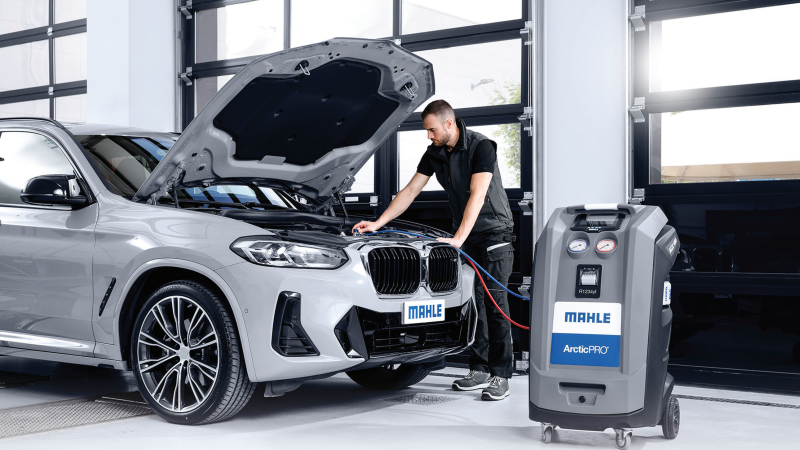
Using the right service equipment also plays an important role in ensuring accuracy. The Mahle ArcticPRO air conditioning service machines are designed to help workshops perform precise and repeatable A/C servicing while ensuring PAG oils are applied correctly.
The machines carry out a fully automatic process including refrigerant recovery, vacuum and refill, helping reduce the risk of manual error. A patented coupling system with zero gas loss prevents refrigerant escaping during servicing, helping workshops save money on refrigerant while reducing environmental impact.
Mahle air conditioning service units also feature timed automatic oil injection with an integrated cleaning function, allowing the correct quantity of oil to be introduced into the compressor without manual intervention. In addition, the system incorporates an oil care system using hermetically sealed bottles, which protects fresh oil and UV tracer from moisture contamination and helps preserve lubricant quality.
Together, these features ensure the correct refrigerant and oil quantities are applied consistently, supporting reliable compressor operation and long-term system performance.
The importance of getting it right
For workshops, choosing the correct lubricant is not simply a technical detail, it can determine whether a repair lasts or results in repeat failures. Best practice also dictates that when replacing a failed compressor or switching oil types, the entire A/C system should be thoroughly flushed to remove contaminated oil and debris.
Different compressor designs, refrigerants and vehicle architectures all require specific lubricant formulations. Motor factors therefore play an increasingly important role in helping technicians select the correct product and ensure reliable A/C system performance.
Mahle’s portfolio of compressor oils reflects this growing complexity, covering PAG, PAO and POE formulations for conventional vehicles, hybrid and electric platforms and a wide range of refrigerants.
As air conditioning systems continue to evolve alongside vehicle technology, the role of lubricants will only become more critical. Understanding the differences between oil types, and using the correct tools to apply them accurately, remains essential to keeping modern A/C systems operating efficiently and reliably.