Electric vehicles are, among other things, a good deal heavier than their internal combustion engine counterparts in fact, up to half a tonne heavier. Accordingly, the wear on tyres is greater, but also produces different outcomes. Here, Giti Tire provides their expertise to aid readers in tyre wear diagnosis.
Electric vehicles do not require workshops to abandon the fundamentals of tyre diagnosis, rather they require technicians to apply those fundamentals with tighter control over load, pressure, geometry and vehicle history.
That distinction matters. Some battery-electric vehicles are heavier than comparable combustion models, and electric motors can deliver high torque from very low speed. Both can increase the forces passing through the contact patch. But rapid or uneven EV tyre wear should not automatically be blamed on the battery or the powertrain. Vehicle mass is one factor among many, including inflation pressure, alignment, suspension condition, tyre specification, road use and driver input.
The practical change is therefore not a new list of wear patterns. It is a more disciplined diagnostic process, one that starts with the vehicle’s approved specification and records enough evidence to separate normal service wear from a correctable fault.
Start with the vehicle, not the EV label
Before interpreting the tread, confirm the exact vehicle, derivative, wheel and tyre combination. Two versions of the same model can have different kerb weights, axle loads, tyre sizes and cold-pressure requirements. Optional wheels, towing use and frequent heavy loading can change the picture again.
The workshop baseline should come from current manufacturer information, the tyre placard, owner information and applicable service data. Record the specified size, load index, speed rating and cold pressures before deciding whether the fitted tyre is suitable or the observed wear is abnormal.
An XL marking, a high load index or an ‘EV’ description should not be treated as a substitute for checking the vehicle’s approved fitment. Nor should a technician assume that any tyre matching the nominal size will deliver the same load capacity, rolling resistance, noise behaviour or durability.
Measure the wear before explaining it
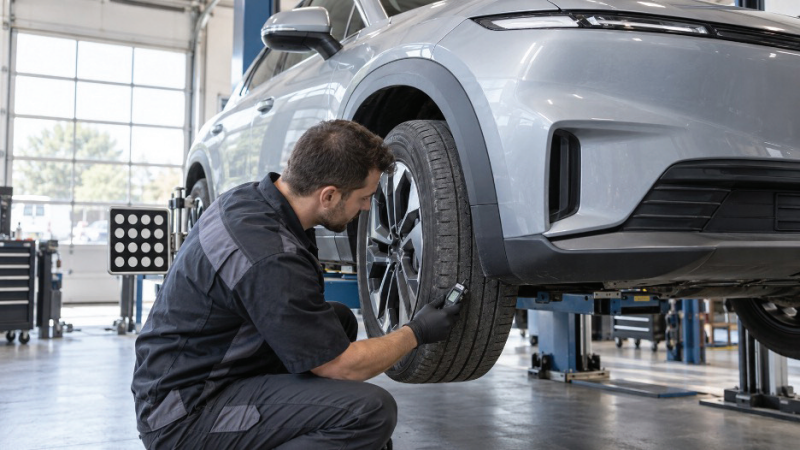
A quick glance at the outer shoulder is not enough. Measure each tyre at repeatable points across the tread and record the position on the vehicle. Comparing front to rear and left to right often reveals more than looking at one tyre in isolation.
A useful inspection record should include:
-
Tread depth at the inner, centre and outer zones of each tyre.
-
Cold pressure, where possible, compared with the vehicle specification.
-
Odometer reading and, if known, mileage since fitment or rotation.
-
Tyre make, pattern, size, load and speed rating, and production identification.
-
Signs of feathering, cupping, localised scuffing, cracking, impact damage or repair.
-
Which axle and corner each tyre occupied and
-
The customer’s typical use, including urban acceleration, motorway mileage, towing and repeated heavy loads.
-
Record the DOT tyre code as part of the inspection, but do not treat the manufacturing date alone as proof of a tyre’s condition. Storage history, environmental exposure and physical condition also matter.
Treat the pattern as a clue, not a verdict
Traditional pattern recognition still helps, but it should guide the next test rather than close the job.
This is particularly important with EV tyre wear because several influences can overlap. A heavier vehicle running slightly below its specified pressure can increase carcass deflection and shoulder loading. Add misalignment or repeated high-torque acceleration and the visible result may have more than one cause.
Pressure errors become more expensive
Inflation pressure affects the tyre’s load-carrying behaviour, footprint, heat generation and rolling resistance. On a heavier vehicle, a pressure error can consume the available operating margin more quickly, so the accuracy of the measurement matters.
Use a calibrated gauge and compare like with like. A warm tyre reading cannot be judged as though it were a specified cold pressure. If the customer has just arrived, record the condition and avoid releasing or adding pressure on the basis of an invalid comparison.
Check for seasonal temperature change, slow punctures, valve leakage and damage where pressure loss is reported.
Alignment deserves evidence, not guesswork
The combination of high vehicle mass, wide tyres and low-profile fitments can make geometry errors costly. A pothole strike or worn suspension component may place toe or camber outside tolerance, but replacing the tyres without identifying the cause simply resets the clock.
Inspect for play and damage before relying on alignment readings. Confirm wheel and tyre condition, ride height and any manufacturer requirements for loading, calibration or driver-assistance systems. Then produce before-and-after measurements. A green screen is not enough if the equipment used the wrong vehicle variant or a worn component allowed the setting to move under load.
Account for torque and regenerative braking, carefully
Instant torque can increase tread stress when the driver repeatedly asks for strong acceleration, especially from low speed. Regenerative braking can also change how deceleration work is distributed through the driven wheels.
Neither feature creates one universal EV wear pattern, because control software, drive layout, suspension geometry, tyre design and driver behaviour vary widely.
Ask specific questions instead of telling the customer that ‘EVs eat tyres’. Is most use short urban journeys? Is the vehicle driven in a high-performance mode? Has the wear appeared on the driven axle, one corner or all four tyres? Has the rotation procedure permitted by the manufacturer been followed? The answers help separate operating pattern from a pressure, geometry or component fault.
Replacement choice is part of the diagnosis
A replacement tyre must satisfy the vehicle manufacturer’s size, load and speed requirements and any other applicable specification. Beyond basic fitment, the workshop may also need to discuss durability, wet grip, rolling resistance and noise according to the customer’s use.
Tyre manufacturers are addressing these competing requirements through compounds, constructions and pattern designs intended to work across modern powertrains. Giti Tyre’s EV-ready tyre development is one example of how weight, torque, efficiency, noise and durability are considered together rather than as isolated features.
Heavier EVs can increase the consequences of poor pressure control, unsuitable fitment and small geometry errors. They can also expose weak workshop habits: visual-only inspection, no baseline measurements and an assumption that the powertrain explains everything.
A defensible diagnosis does the opposite. It verifies the vehicle specification, measures every tyre, checks the mechanical causes and accounts for how the vehicle is used. That approach is more useful than blaming EV weight and it gives the customer a clear reason for every recommendation.