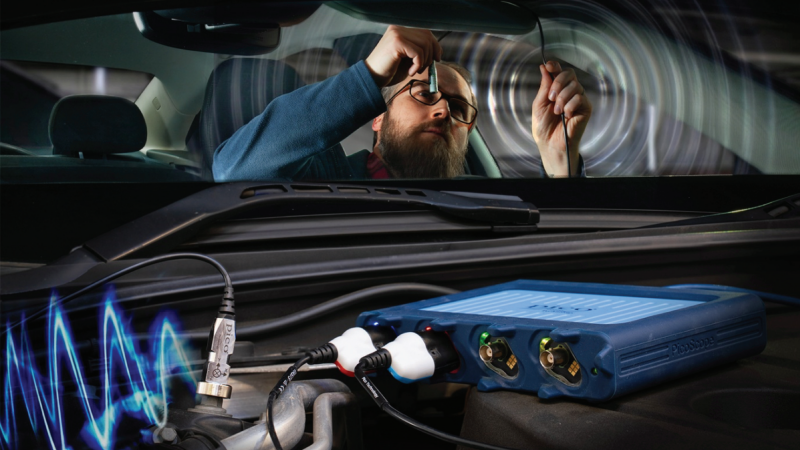
On the eve of Pico’s latest product launch – the PicoBNC+ NVH range – PMM editor Kieran Nee caught up with the oscilloscope maker’s senior product marketing manager Dr Barney Donohew to find out more.
There is a paradox clinging on to the back of the freight train called Progress – at least in the world of automotive. The more advanced cars and their engines become, the smoother and quieter the ride they provide for their drivers, meaning that every minor nuisance becomes amplified far more than before. When the engine whispers like a spring breeze through a willow tree on a village green, the sudden squeal of brakes disrupts the tranquil scene like a drunkard on the next bench shouting at anyone who will listen.
This is what has become known as Noise, Vibration and Harshness and beyond being a nuisance in and of itself, it can be a symptom of something more serious within the vehicle itself. Many workshops have started specialising in this area of work and whilst locating the source of a squeaky brake might not prove too troublesome, there are many squeaks and rumbles which haunt vehicles like elusive phantoms, requiring technicians truly adept at the dark arts to track down.
Well, that is until now. Pico Technology is bringing NVH diagnostics out into the open and making it more accessible to technicians with its new product launch: The PicoBNC+ NVH diagnostics probes and kits, bringing together microphones, three-axis accelerometer and using the same software as the standard PicoScope, meaning the data is easier to read than ever before. To really drive home the idea that this is an area of diagnostics they are opening up to less experienced fault-finders, they are launching three separate kits for Starter, Standard and Advanced for automotive and commercial applications.
Hi Barney, how’s the product launch going?
It’s quite a big one for us, actually. We’ve been waiting on this for quite a while and we’re hoping it’s really going to make users’ lives a lot easier. With the full four-piece kit you get four microphones, four accelerometers, and also four extension leads, as well as the accessories you need. There’s everything you need in there basically to get going. On the other end of the spectrum, to offer the kit at a lower price point and as a perfect introduction to technicians unfamiliar with NVH diagnostics, we offer the probe microphone and extension cable without a case, which does offer a significant saving, believe it or not.
You’ve had equipment for measuring NVH available before this, right?
Yes, we had a previous kit with your open standard BNC connector, those kits were very effective, but you had to have an interface box which had a battery in which would run out. It was more hassle and you would have to change which software you were using in accordance with the hardware settings.
How does the BNC+ simplify set-up?
You can plug it straight into your PicoScope and the settings adapt, so people aren’t going to make mistakes. When you record a measurement, what you see on the screen is the right thing – you don’t have to go through mental gymnastics, multiplying or adding anything. There’s a lot to learn with NVH, frequency, amplitude, vibration orders… so you want to keep everything as simple as possible. It’s a plug and play set up, really.
Apart from simplifying set-up, what does this kit bring to the table which other NVH kits don’t?
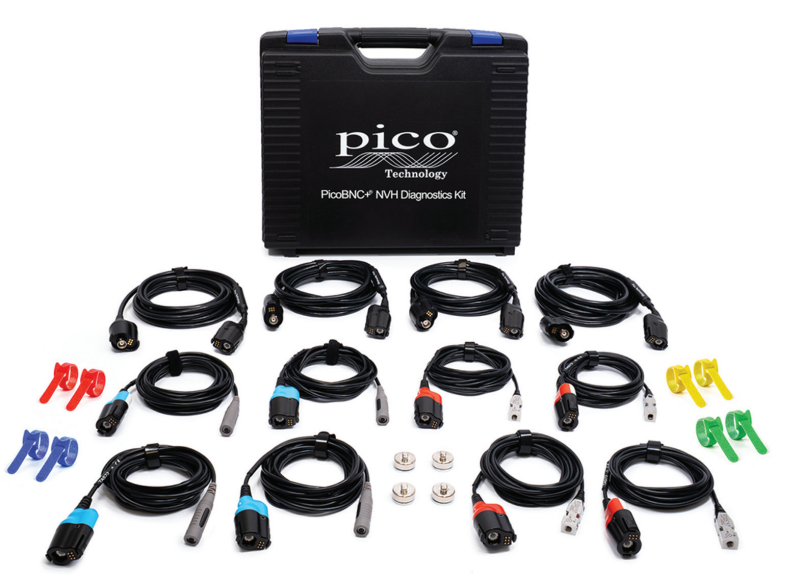
One of the big features, and it’s something I haven’t seen on any other oscilloscopes, is providing a three-axis accelerometer on the one channel. So you can measure the three axes: fore and aft; lateral; and vertical
vibrations on one channel rather than three. This means, with the four channel scope, you can measure all four corners of the car at the same time. So you can hook up the kit, take it for a test drive and get all your measurements in one go. You know how difficult it can be to replicate an intermittent vibration, so this is potentially a huge timesaver for technicians.
How could this change a technician’s approach to diagnostics?
Mechanical faults, by and large, manifest themselves through NVH symptoms. Not always, but usually. So this kit could help a technician locate and diagnose a fault through the NVH symptom. People are very used to using oscilloscopes for electrical diagnosis, sensors and then pressure too. This NVH kit is the leap into the mechanical world, which is two thirds of workshop diagnostics. Electrical faults are actually rarer than simply having a customer coming in and saying, there’s a knock or a vibration, can you sort it out.
Is it a bigger problem now that modern vehicles are so smooth?
Yeah, 100 per cent. So electric vehicles are a key example, with people starting to hear things they never used to hear because suddenly you haven’t got the engine masking things, the kind of noises that were always happening. You can chart the rise of interest in NVH and the uptake of EVs and they go hand in hand. One thing to always keep in mind is that cars are designed to vibrate and make noise. Sometimes you have a garage customer who thinks that a perfectly normal noise is an issue. That’s why it’s advisable to build up a bank of datasets for common vehicles, so you have a standard against which you can compare the same make and model.
Who is going to buy this, do you think?
I think this will open up the market a bit more than before – certainly the “scope-curious” to use a Pico-ism will be intrigued. Traditionally NVH was an intermediate and above area of expertise, you’d be thinking about master technicians and beyond. We’re removing the intimidation with this kit, allowing less experienced techs an easier way in and then they can go into as much depth as they need or want to, all with the same tool.