Engine oil has come on in leaps and bounds in recent years to eke out every iota of efficiency from an engine. But it’s not the only fluid playing a vital role under the bonnet. Here, Morris Lubricants’ technical director Adrian Hill highlights the importance of antifreeze coolants.
It’s no secret that engine oil technology has moved at a fair pace over recent years to keep up with engine hardware changes introduced to improve fuel efficiency and reduce emissions. However, there are other vital fluids that work behind the scenes that are just as essential to optimise an engine’s operation and these are antifreeze coolants. Antifreeze coolants are often-misunderstood products, but they do provide a wide range of benefits when used in passenger car engines. They are far more than just a coloured fluid.
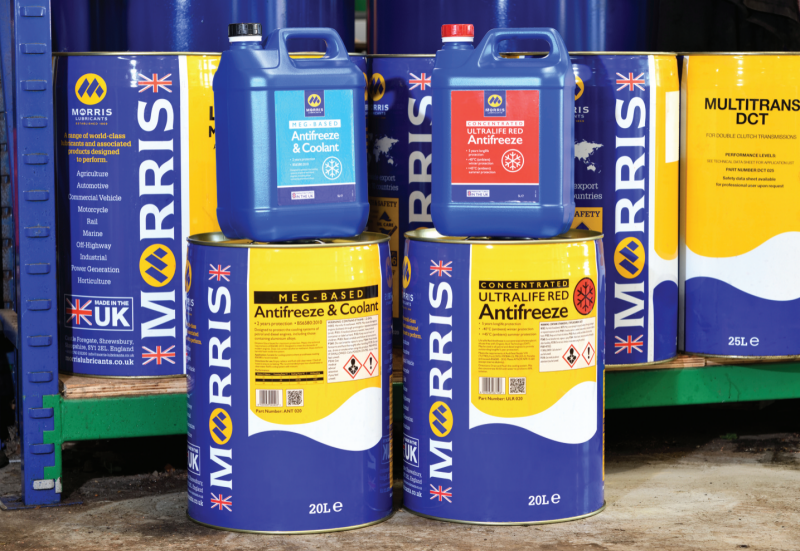
Internal combustion engines generate heat and are designed to run at an optimum temperature for maximum efficiency. Whether a passenger car is being driven or left standing, using the correct antifreeze coolants is vital. They are critical fluids that help ensure engine operational efficiency, while protecting engine components and maintaining reliability.
High temperature operation
When a passenger car engine reaches running temperature, it is essential that it doesn’t exceed this as damage can arise. Water is great as a cooling medium, however, there is a catch. In the hotter parts of the engine, particularly around the combustion chamber area, the temperature will exceed the boiling point of water. If the water boils away, catastrophic damage can occur. At abnormally high temperatures, engine components can expand, affecting build tolerances and potentially causing seizure or disastrous failure. To combat this, the addition of Monoethylene Glycol (MEG) typically raises the boiling point up to around 108°C. Engine cooling systems are pressurised raising this further to between 120°C and 130°C. This provides a good level of safety margin and prevents boiling and thus protecting the engine.
Low temperature operation
Before any passenger car engine reaches its optimum operating temperature, it has to start from cold. As highlighted above, the best cooling medium is water, which is extremely effective at removing heat and ensuring that the engine operates at its optimum temperature. Great news, but at 0°C water freezes and turns to ice. This is an issue when ambient temperatures are very low. Ice is less dense than water and expands, taking up a greater volume in the cooling system. When this happens in the engine cooling system, there is nowhere for this expansion to take place, and high internal pressures can be generated that can crack heads, cause splits in cylinder liners and damage hoses etc. MEG is added to the water to reduce its freezing point, potentially driving it down to -35°C. This is very effective and the MEG works by disrupting the formation of ice crystals.
The role of inhibitors
The use of antifreeze coolants in passenger cars has many other benefits which are supported by the addition of various inhibitors. These inhibitors provide further important functions of an antifreeze coolant including the prevention of any metallic components in the cooling system from rusting or corroding. For these benefits to work, essential additional chemistry is required. The inhibitor package is a combination of chemical compounds chosen to optimise its ability to protect the cooling system. This chemistry is referred to as either inorganic or Organic Acid Technology (OAT).
Inorganic chemistry is extremely active and will seek out all materials in the cooling system, whether susceptible to rusting/corrosion or not. This constant level of activity results in it becoming depleted after around two years. At this point it should be drained and changed.
Organic Acid Technology only targets materials where rusting/corrosion is starting to take place. This chemistry is selective and does not become depleted as quickly and will work for up to five years. Some manufacturers may require a combination of these technologies and ‘hybrid’ antifreezes are available for specific engine designs. For instance, one ‘old school’ addition, in the form of silicate, is very effective at protecting water pumps and may be added to a five-year OAT antifreeze coolant to boost performance.
The OEMs that design the passenger car engines are very particular about the type of chemistry used in the formulation of antifreeze coolants. As the designs of engines evolve and become more complex, so too does the formulation of the antifreeze coolants to help ensure efficient and effective operation.
Additional additives
Cooling systems found in petrol, diesel and hybrid engines are manufactured using a wide variety of materials, including metals, alloys, plastics, rubber and elastomers. All these components must be protected from rusting, corrosion, deterioration and degradation etc. Additional additives may also form part of the antifreeze coolant to help protect these materials, such as antioxidants to stop corrosive acid formation, as well as compounds to prevent hard water deposits. The addition of pH buffering agents are present to maintain an optimum pH level (around 8.0) which, like antioxidants, stop the formation of acids that can attack cooling system materials, particularly metals.

Furthermore, as the antifreeze coolant is pumped and churned around the cooling system, air can become entrained, so the product must also have antifoaming properties. Foam is basically air bubbles, and air is not very good at removing heat. This will not only lead to overheating, but also cavitation that will impede antifreeze coolant flow, making matters even worse. Antifoam chemical additives ‘break’ the foam and release the air.
Don’t select on colour
The final characteristic is colour. The language of antifreeze coolants tends to be based on their colour. But be aware, colour is not an indication of quality or performance and is purely cosmetic having no impact on how the antifreeze coolant performs in terms of engine protection.
The many different engine designs mean that there is no single antifreeze coolant that is universally suitable for all types of passenger car engines. Antifreeze coolant formulations are developed and tailored to meet the strict demands of the OEMs, of whom there are many.
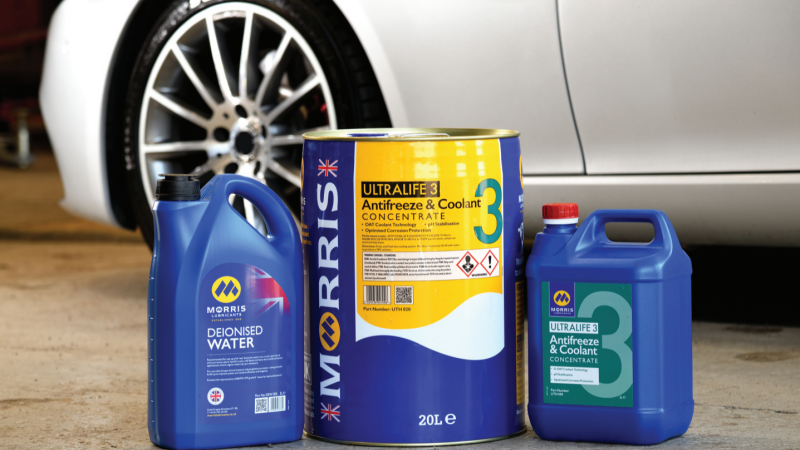
Morris Lubricants has developed the Ultralife range of antifreeze coolants to cover a wide range of petrol, diesel and hybrid engines and across many different manufacturers. The Ultralife range is ideal for fleet managers, dealerships and mechanics that are responsible for a variety of different vehicle technologies, OEM brands and vehicle models.