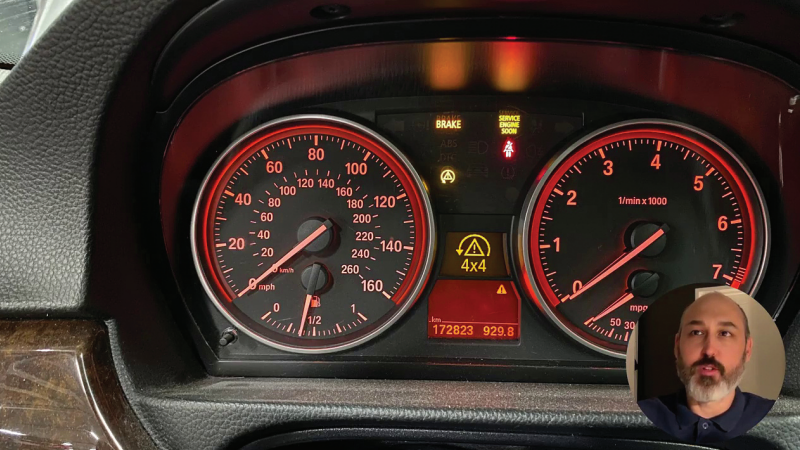
PMM’s hot-wired herald Ben Johnson brings news of a fault-filled E90 with a dashboard rivalling Piccadilly Circus for bright lights and razzle-dazzle. But what could be holding back this German gizmo’s get-up-and-go?
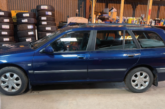
There are few things quite as persuasive as a BMW dashboard when it decides the world is ending. A case in point was a recent veteran I had come before me in the workshop – an E90 whose dashboard was lit up with transmission, all-wheel-drive and stability-control warnings. A diagnostic scan told the same apocalyptic story with more than 50 faults across the car coming together with seemingly one goal in mind: To ruin my week.
Looking through the list, there was a CAS terminal 50 complaint relating to the starter command, along with repeated undervoltage and missing-message faults in several control units. The airbag system, instrument cluster, CIC and DSC were all represented in the electronic misery. I cheered myself up with the knowledge that that Santa’s list of naughty components did not mean that all of those modules had failed. It just meant they had all experienced the same bad day.
When supply voltage collapses, control units reset, stop transmitting or report messages missing from other modules. The resulting scan can look like a communication catastrophe, but the fault list is often describing the consequences rather than the cause. Fifty codes do not necessarily mean fifty problems. Sometimes they are simply fifty witnesses pointing towards one weak electrical supply.
The vehicle also produced an obvious no-crank condition. That brought the starter circuit into the investigation, but it did not condemn the starter. A starter motor is one of the largest electrical loads on the car. If the supply path cannot carry current, it will expose the weakness very quickly.
“Fifty codes do not necessarily mean fifty problems. Sometimes they are simply fifty witnesses pointing towards one weak electrical supply.”
Reading the pattern, not the list
A failing junction box was worth considering because these cars are known to suffer power-distribution problems. However, the central locking still operated. That did not prove the junction box perfect, but it weakened the theory because central-locking trouble is commonly one of the first visible symptoms when that unit loses its main supply.
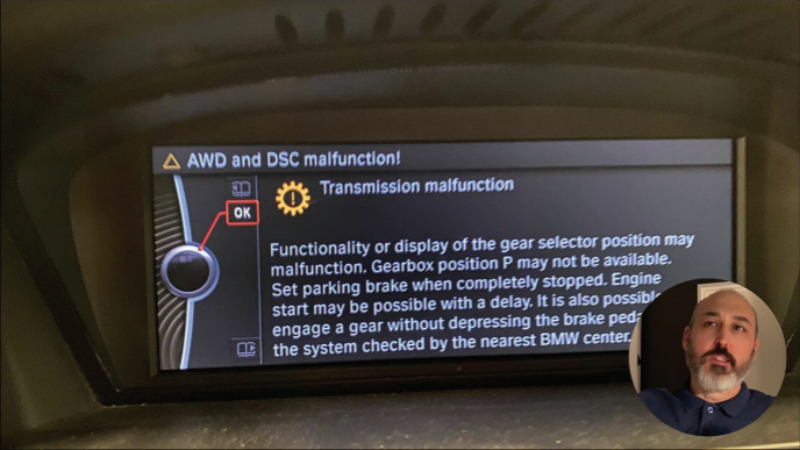
The iDrive display reported AWD/DSC and transmission malfunctions. These were symptoms within the wider low-voltage
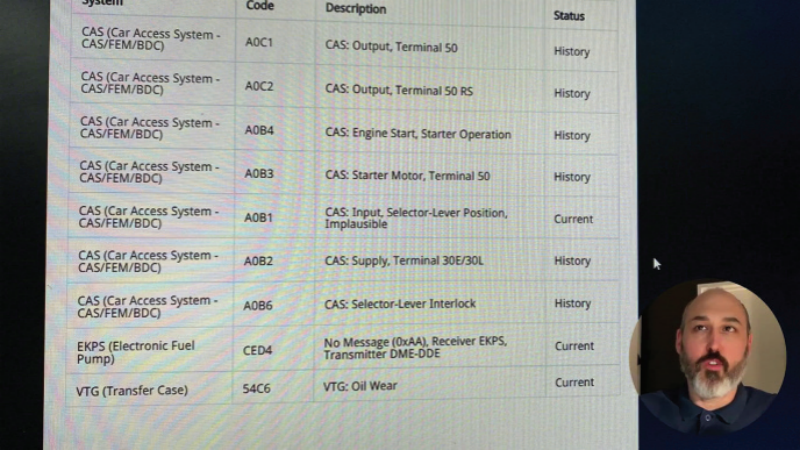
The scan contained numerous undervoltage and missing-message faults across several systems. The pattern mattered
The useful pattern was broader: Widespread undervoltage, missing communications and a starter that would not operate properly. Before opening control units, ordering a starter or disappearing into wiring diagrams for half a day, the sensible question was whether battery voltage could actually travel from the rear of the car to the front.
The earth side had already received attention. Someone had replaced the original ground lead with what appeared to be a positive cable, then covered it in black so that its new career as an earth cable looked respectable. It was not factory-pretty, but the cable was substantial and better than the original item it replaced. That made the main positive feed the next obvious path to test.
This is where diagnosis becomes pleasantly unfashionable. No software update, no module programming and no parts cannon. Just two voltage readings taken at opposite ends of a very thick cable.
An unloaded test that should have been boring
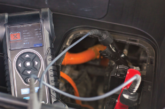
The battery was in the boot and a charger was connected, so the first measurement was taken at the rear supply point (Fig. 3). The reading was 13.36 volts. At the front jump-start terminal (Fig. 4), the meter showed 13.81 volts.
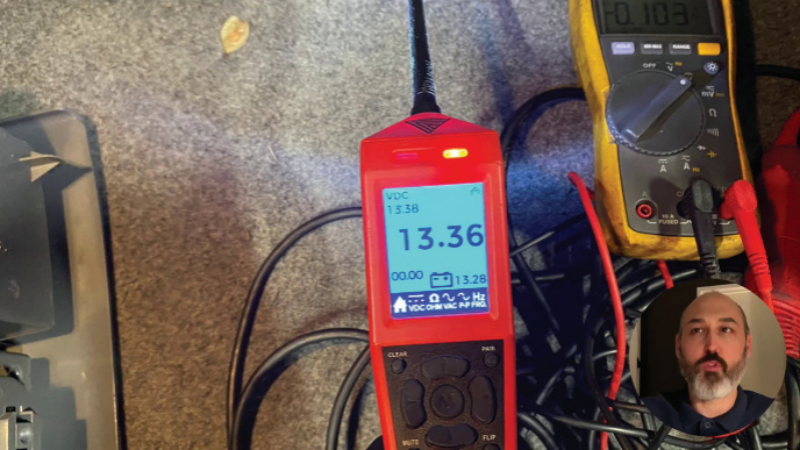
With the charger connected, the rear measurement showed 13.36
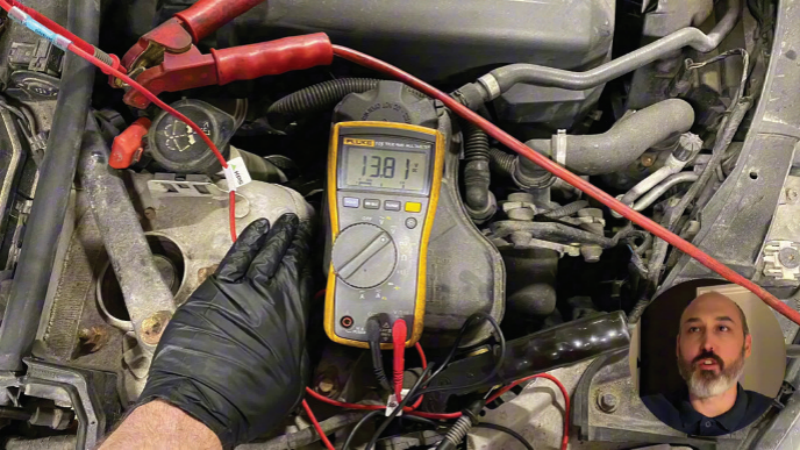
The front jump point showed 13.8 V, leaving an abnormal difference of roughly 0.45 V across the main B+ path even without cranking.
The important figure was not either voltage on its own. It was the difference between them: Roughly half a volt across the main B+ cable. That should not have been there.
At this stage the circuit was not being asked to crank the engine. There was no enormous starter current flowing through the lead. Yet a cable roughly as thick as a thumb was already losing around 0.45 volt from one end to the other. A sound main cable should make an unloaded comparison spectacularly dull. Both ends should sit at virtually the same potential.
Voltage drop is often misunderstood because technicians measure battery voltage, see a respectable number and move on. The battery can be healthy and the cable can still be useless. A voltmeter connected at one point only tells you what is available there. Comparing the two ends tells you what is being lost along the route.
The moment that unloaded difference appeared, the case had changed. There was no need to wonder whether the car might have a supply problem. It had one. The remaining task was to find where the resistance lived and prove how badly it behaved under load.
The failure hiding under the cap
The physical evidence was not shy once the main cable connection was inspected. The terminal cap had split and the surrounding metal showed severe corrosion, with green deposits and rust around the connection (Fig. 5). Water had been entering the boot and had never been properly dealt with. In winter, trapped water had frozen and expanded, cracking the terminal housing. Moisture then worked from the inside out and travelled along the cable connection by capillary action. What looked from a distance like a heavy, indestructible B+ lead had become compromised at the point where current had to pass through the terminal.
The cable itself may have looked serviceable further along its length, if somewhat tired, but the end connection was finished. The corroded terminal was expected to crumble when unbolted. This was not a connection to clean, tighten and send back into service with a hopeful expression. The full cable required replacement.
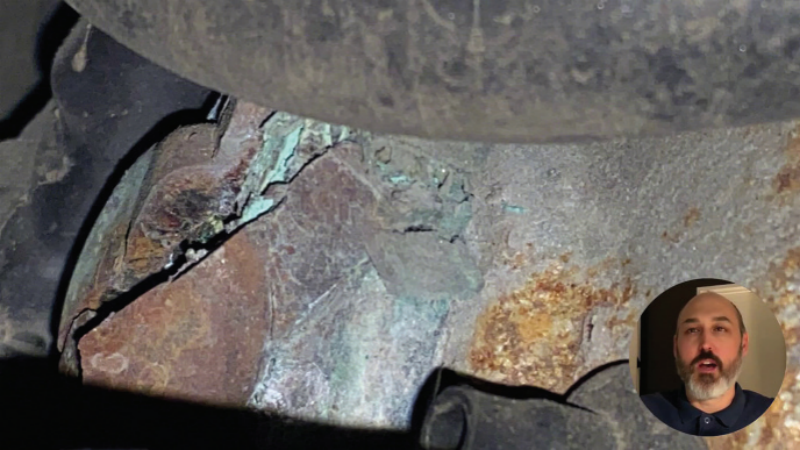
The split terminal housing and heavy green corrosion revealed physical failure at the main positive cable connection.
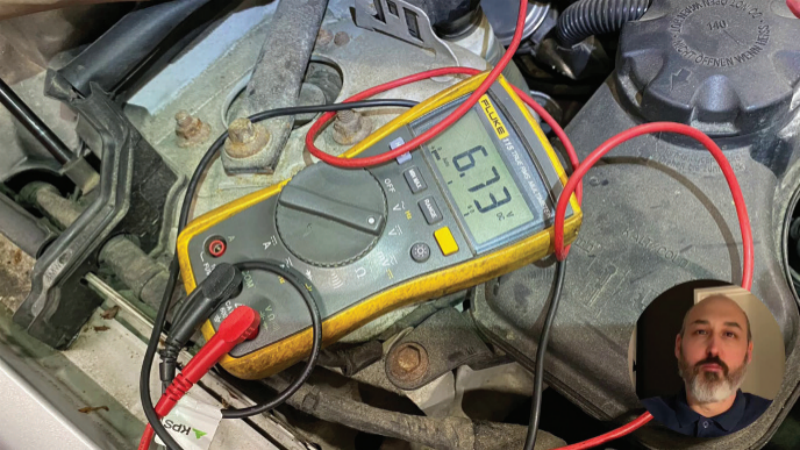
During the loaded start attempt, the available voltage fell to 6.73 V after only a few seconds.
This is an important distinction. Corrosion on the outside can sometimes be superficial. Here, the split housing and evidence of moisture migration showed that the deterioration was inside the electrical joint. Cleaning the visible surface would not restore the missing cross-sectional area or remove resistance hidden within the crimped and bolted sections.
Loading the circuit makes the fault confess
The unloaded test had already proved an abnormal drop, but the cranking test showed what the driver experienced.
With one person operating the start control and the voltage monitored at the front, the supply immediately fell to 8.17 volts on the first attempt. After only about five or six seconds, it collapsed further to 6.73 volts (Fig. 6).
That is not a subtle loss. At those voltages, control units begin dropping off the network, relays cannot behave normally and the starter has little chance of doing useful work. The transmission, DSC and communication warnings were not separate mysteries. They were the electronic fallout from a supply system falling on its face.
The resistance in the cable restricted current flow and consumed voltage. Under load, the effect became far more dramatic because the voltage lost across a resistance rises with current. The missing electrical energy did not vanish. Much of it appeared as heat at the damaged connection and cable.
This is why a loaded voltage-drop test is so effective. Resistance measurements on heavy cables can be misleading because the values involved are extremely small and ordinary meter leads introduce their own resistance. Testing the circuit while it is doing the job reveals whether the complete path can carry current. In this case it could not.
Heat and charger current: Clues you can feel
The charger added another piece of evidence. After only two or three minutes, the cable became extremely uncomfortable to hold and was estimated to be above $50^{\circ}\text{C}$. A main battery lead should not become hand-warming equipment simply because a charger has been connected.
The charger display showed 14.8 volts and 72.7 amps. At the front jump point, only about 13.8 volts was available. The battery had also been tested and was not merely flat, although its measured capacity was down by roughly 200 amps. The exceptionally high charger current therefore needed to be considered alongside the voltage difference and the heat in the cable.
All three observations told the same story. Current was trying to pass through a high-resistance connection. Voltage was being lost before it reached the front of the car, while energy accumulated as heat in the damaged area. The cable was not transmitting power efficiently; it was obstructing it.
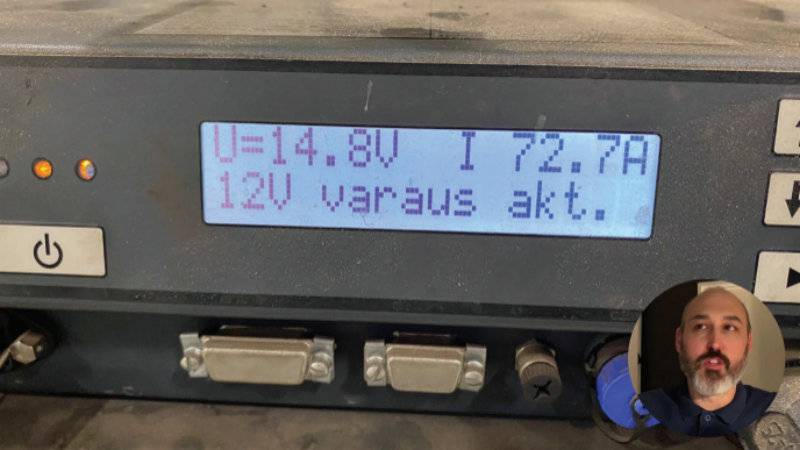
The charger displayed 14.8 V and 72.7 A. High current, cable heating and lower voltage at the front all supported the resistance diagnosis.
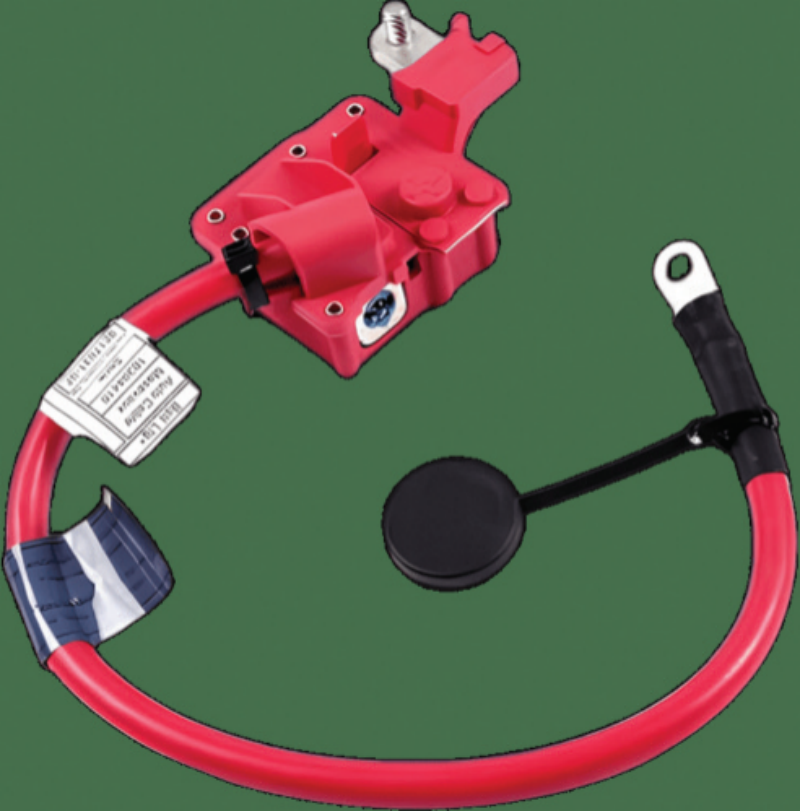
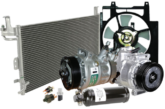
A complete positive battery lead and safety-terminal assembly illustrates the type of unit required rather than a cosmetic repair to the damaged cap.
Heat is a valuable diagnostic clue, but it should not replace measurement. A warm terminal may tell you where to look, while a voltage-drop test proves whether that point is affecting circuit operation. Here, the temperature, the unloaded drop and the cranking collapse supported one another perfectly.
What had to be replaced
The required repair was the complete main positive cable, not just the visible cap. The damage had progressed through the terminal area and into the cable connection, making a local cosmetic repair inappropriate.
The safety battery terminal also required replacement. This assembly contains a small pyrotechnic device intended to disconnect the battery supply during a serious collision. Once its surrounding cable and connection have suffered this level of corrosion and structural damage, it cannot sensibly be treated as an unrelated reusable part.
The proper finish to the job would therefore be replacement of the affected B+ cable and safety terminal, a new cable the full length of the car, correction of the boot water leak, then repetition of both unloaded and cranking voltage-drop tests. The fault codes would also need clearing before a fresh vehicle scan confirmed which complaints were genuine and which were simply scars from the undervoltage event.
Five minutes, provided you measure the right thing
This fault was found in roughly five minutes because the test matched the symptom. The car had widespread undervoltage faults and would not crank, so the main power path was checked from end to end. The first comparison already showed an impossible loss. Loading the circuit then made the failure undeniable.
It would have been easy to replace the battery, condemn the starter or become distracted by the transmission warning. None of those actions would have repaired a rotten cable hidden in the boot. The dashboard was noisy, but the electrical principle was simple.
The wider lesson applies to any make of vehicle. When a car presents with a no-crank condition and a scan full of low-voltage chaos, do not count fault codes and assume each one deserves a part. Check whether voltage reaches the load. Compare both ends of the supply and ground paths. Test them unloaded if the difference is already suspicious, then load the circuit and watch what happens.
A cable can look thick enough to tow a small boat and still be electrically useless at one corroded connection. The meter does not care how impressive it looks. Neither should the diagnostician.