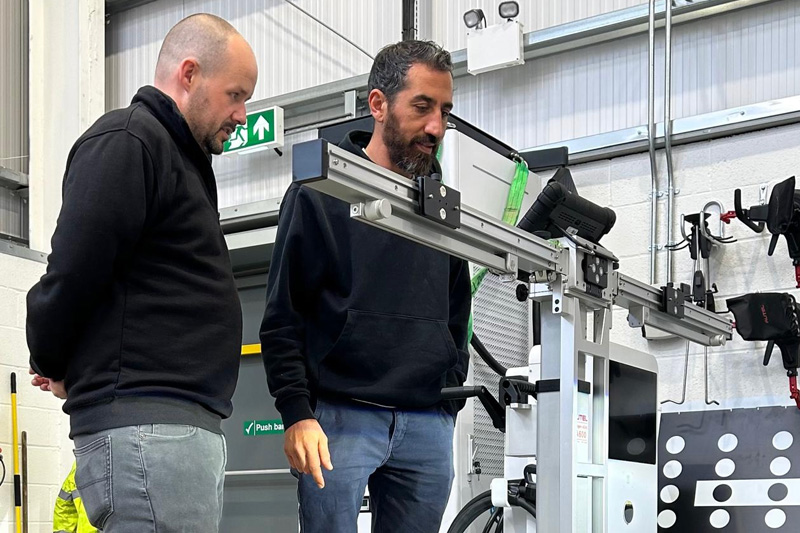
Bringing ADAS calibration in-house is a decision many workshops are now considering, but choosing the right equipment can be the difference between a profitable service offering and a liability risk. We spoke to Matt Hume at A1 ADAS Group about the calibration rig he uses in-house himself.
The Autel IA600 is one of the latest fully digital ADAS calibration rigs available. It’s also the only digital mobile system on the market, using camera-based positioning to remove the need for manual measurements. Matt Hume at A1 ADAS Group uses the IA600 for a lot of the company’s own workshop and mobile calibration work, so we asked him to talk through what it’s really like to use, from setup and pre-checks to reporting and speed.
What makes the IA600 different from other ADAS rigs on the market?
The biggest difference is that the IA600 is a fully digital camera-based system. It uses six cameras mounted on the crossbeam to position the rig and check the vehicle before calibration even starts. It knows exactly where the vehicle is, exactly where the rig is, and whether everything is within tolerance before it allows you to continue.
With more manual systems, you’re relying on lasers and measurements to find the vehicle’s centreline, which can involve guesswork. With this, the thrust angle and alignment are measured electronically, which makes the setup far more accurate and repeatable. It’s also the only digital mobile ADAS rig on the market, which makes it practical for technicians working in different environments and for workshops that don’t want a rig permanently set up on the floor.
You mentioned alignment pre-checks. How important are those before calibration?
They’re critical, and it’s something that’s often overlooked. The IA600 can carry out a pre-alignment check using wheel clamps and the cameras on the frame, so you can see straight away whether the vehicle geometry is correct before you even attempt a calibration. If the vehicle isn’t within tolerance, then technically, you shouldn’t calibrate it because most manufacturers specify that alignment must be correct first.
With this system, you can prove that check has been done. It’s especially useful for workshops that don’t have wheel alignment equipment on site, because they can confirm the vehicle is within tolerance before continuing with the calibration, rather than just assuming everything is straight. It helps make sure the repair process is being followed properly.
Does carrying out those extra checks slow the job down?
Not with this system, because the setup is so fast. One of the biggest strengths of the IA600 is how quickly the rig can be positioned. Because the cameras measure everything digitally, you can place the rig in minutes instead of spending time lining it up manually.
On a typical job, including the diagnostic pre-scan, the alignment pre-check, the calibration itself and the post-scan, you can be done in around 15 minutes if the vehicle is within tolerance. That’s the full process from start to finish, not just the calibration on its own. The crucial thing is it’s not just quick, it’s precise.
How important is reporting when it comes to ADAS work?
It’s absolutely vital. Aside from the obvious liability implications, ADAS is an ‘invisible’ process, and the customer can’t see what you’ve done. You need something that proves the work was necessary and shows it was carried out correctly.
The IA600 produces one clear report that includes the pre-scan, post-scan, alignment check, calibration results and confirmation of the setup. Some systems give you separate reports or data that only a technician can understand, but with this, the information is easy to follow. That also makes it easier for front-of-house staff to explain the work and justify a cost the customer may not have seen before.
Is the IA600 suitable for workshops where space is limited?
Yes, and that’s one of the reasons it’s so popular. The rig doesn’t need to stay set up all the time, so it suits workshops where space is tight and the floor area has to be used for different jobs during the day. You can move it into position when you need it, carry out the calibration, and move it out of the way again. Because the positioning is digital, the system confirms everything is correct each time you set it up, so you’re not relying on it being fixed in one place. It provides practicality as well as reliability for real workshop conditions.
What comes with the IA600 as standard?
The IA600 is supplied as a complete bundle with the frame, camera kit, wheel clamps, radar plates and a selection of the most commonly used calibration boards, so it covers the majority of vehicles you’re likely to see. Through A1, the package also includes software activation, installation, an IMI training course and ongoing support. These are important additions because this isn’t equipment you should just be left to figure out yourself.
As standard, the system will calibrate multiple ADAS functions including cameras, radar, lane departure, adaptive cruise and collision systems. Extra targets can be added if needed – Alfa Romeo, for example, is quite specialist – but most workshops find the standard kit covers the bulk of their work.
Do technicians need specific training to use a system like this?
Yes, absolutely. ADAS is a potentially life-saving safety system, so you must be able to prove competence. That’s why when we supply this equipment, we include the training course for IMI AOM230 accreditation as part of the package.
That level of qualification protects the workshop too. If something happened to the vehicle and its ADAS was questioned, you can demonstrate your calibration work was carried out by someone trained and qualified, using the right equipment and following the correct process.
What about return on investment? Can workshops really make ADAS pay?
Yes, and most are surprised how quickly it adds up. A typical calibration might be charged at around £250 depending on the vehicle and the system involved, and some jobs will need more than one calibration.
If you’re doing a few a week, the equipment can pay for itself in just a few months. You’re also saving the time involved in sending the vehicle out to a dealer, which we all know can take weeks. And even for workshops that use mobile calibration services like ours, there comes a point where bringing it in-house can be a very worthwhile investment.