

A revamped speaker line-up sheds insightful light on a complex reality for the aftermarket as European markets continue to prevaricate in the face of an electrified future. For many the complete roll out of EVs will be a shock, but few can say it was a surprise.
Every December the IAAF Conference sets the agenda for the following twelve months and last year’s event was no different. Whilst recent years’ seminars have sounded cautiously optimistic as the UK car parc has continued to age since the pandemic, the lived experience for many in the aftermarket has failed to live up to the rosy picture painted by the stats. Job offerings have fallen in recent months and many garages have signalled their concern for the future of their business. The reason? Well, the cost of living has bitten harder this winter than many expected and the switchover to EVs has slowed down, not only in the UK but across Europe. There is uncertainty over the future of passenger cars and nowhere are drivers more reluctant to go electric than the UK. Experts have been clear that as things currently stand, there is no clear alternative, and point instead to China, where electrification is moving apace. With titans of the European car industry closing plants and reducing production capacity in the face of cheap Chinese imports, many in the aftermarket can’t help but see the clouds gathering, despite healthy growth in the aftermarket itself. Thankfully, all of this was reflected in the speaker line up.
Professor David Bailey: UK Automotive at a Crossroads?
David Bailey is professor of economics at Birmingham University and has appeared on the BBC to discuss the UK automotive sector. He, as was pointed out for him, drives an EV, but won the audience over by getting straight to the facts and telling it how it is.
Car sale forecasts for 2025 from the SMMT are for 2.01mn cars to be sold in the UK. This will be the first time it’s above 2mn since 2019, although in 2019 the figure was 2.3mn and according the SMMT’s figures, we won’t be reaching that again for the next three years. Before 2019, we hit a high in 2016 of nearly 2.7mn, but according to Professor Bailey this was a symptom of an over-inflated market: i.e. too many cars were being sold.
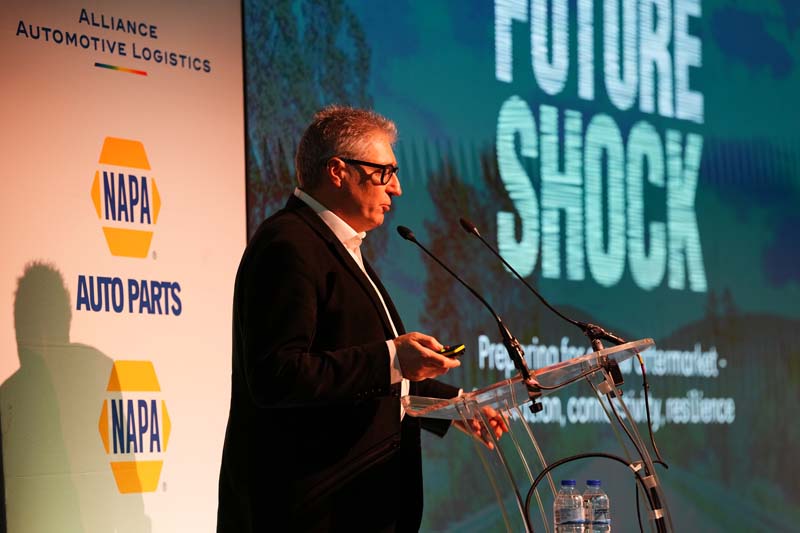
Fully battery-powered EV sales are improving, but not as quickly as hoped. Luckily, the price of the batteries is coming down. The rule of thumb, Bailey tells us, is that if the price per kWh comes below $100, then the EV will be cheaper than its petrol equivalent. Currently in the UK the price sits around $115, but already in China the price is often less than $100. Some analysts, including Goldman Sachs, think the price could drop as low as $80 in the future.
This is good news, as it is the up-front cost of EVs which is putting off UK buyers.
The crux of Bailey’s talk comes with the reveal that the UK’s 2030 ban on the sale of petrol and diesel vehicles hasn’t stimulated investment. The ban is out of line with Europe and elsewhere, with the EV mandate’s sales targets, currently on 28 per cent, moving to 80 per cent by 2030 and then to a full ban. Bailey blasted the “crazy policy” which he says punishes UK producers (who get judged on their total production) whilst Chinese manufacturers who only sell their EV range in the UK get rewarded. According to Bailey, 2030 is also too soon for a realistic transition, and will mean that hybrids become the default choice for the five years leading up to their ban in 2035. Even though vehicle lifespans are now up to 15 years, a 2035 cut-off date would still mean that by 2050 the vast majority of cars will be zero carbon.
Understandably, people were keen to ask questions at the end of Bailey’s talk (and all the rest, to be fair), but unfortunately there wasn’t much time for an extensive Q&A session. When asked is net zero achievable? He responded: “Yes, but we will need investment from China. And there will be a cost. We need to be much more imaginative. Electricity prices need to come down. It’s a crazy policy the Government has announced where gas prices are coming down and electricity is going up.”
Neil Pattemore, a former regular feature of the IAAF Conference, regular speaker at Mechanex and an expert who has appeared countless times in PMM, asked why the UK was committing to a single technical solution, adding that the cost of installing the EV chargers alone was a whopping (our word, not his, I might add) £67.8bn, and to top it off, aren’t we simply offshoring our emissions to China?
If Neil wasn’t sadly retiring this year, it would be great to sit him and David down for an extensive chat on the subject. Given that’s not going to happen we will have to do with our truncated version of an already truncated response: EVs are getting cheaper, chargers are getting installed although rurally they’re not keeping pace with the amount of EVs sold, EVs are greener overall if you keep them going for their full lifecycle, especially as we turn towards greener energy sources and lastly, hydrogen? He’s sceptical it will work for the passenger car market and not convinced that it can be produced in an energy efficient manner. Phew! Time to go and get a coffee before the next talk.
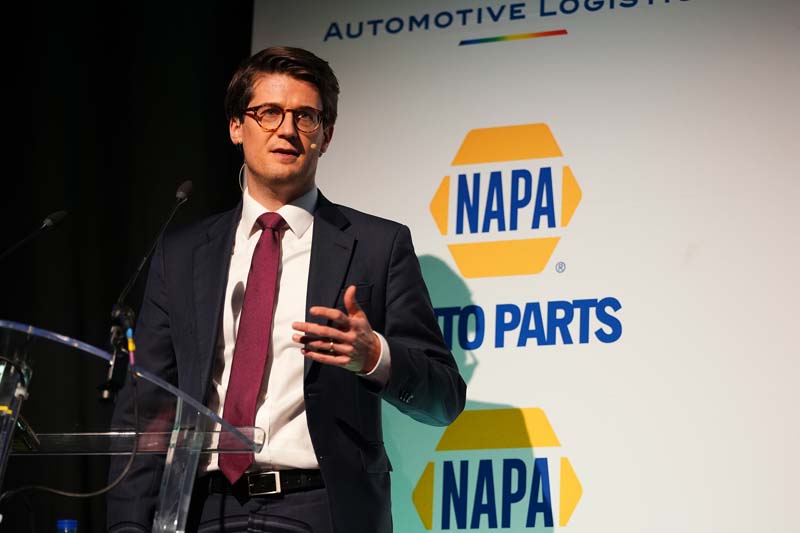
Max Wegner, Roland Berger: State of the Aftermarket in 2025 and models of the future
Max’s talk reinforced David Bailey’s image of a rocky road ahead for the automotive industry as a whole.
Europe, he told the crowd, will be the first continent to reach 100 per cent EVs but it will still be a slower process than previously thought. In a recent survey, drivers were asked whether they are considering buying an EV as their next vehicle, the European average was around 55 per cent in favour, whereas that figure was 60 per cent in 202. Interestingly, in the UK that figure is around 45 per cent, considerably lower than everywhere else.
It was pointed out by both Max and David that Chinese cars are making more headway in the UK that Europe or the US due to the lack of extra tariffs. Max added that history has shown that tariffs only slow China down, but the ultimate trajectory remains the same. China will simply adapt its practices and come back on the attack.
The aftermarket across Europe is growing 3-5 per cent every year. That dynamic, however, will slow down. The car parc will continue to grow, to around 390mn by 2030 from around 375mn in 2022.
Whilst there are more cars on the road, drivers will still start to spend less on maintenance and repair. In fact, 2025 was the first year that the spend has decreased, with a reduction of 1.7 per cent against inflation running at +3.8 per cent. What’s the reason? We are driving 2,000 miles or so less per year compared to 20 years ago. Now the average is around 7,000 miles. The aftermarket’s fortunes depend not simply on the number of cars on driveways but how often they’re actually driven.

![Bosch’s ESI[tronic] diagnostic software](https://pmmonline.co.uk/wp-content/uploads/2026/03/Febi-diagnostics-tool-165x109.jpg)