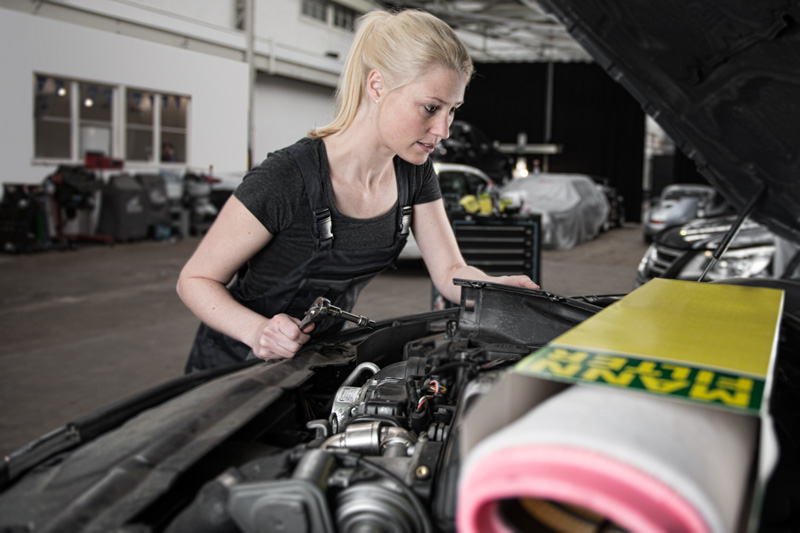
MANN-FILTER, experts in automotive filtration, explains why you shouldn’t even consider cleaning your customers’ air filters.
The air filter is an often undervalued filter, with the ‘oil and filter’ interim service or perception that the air filter is of secondary importance to the engine commonplace. There are many stories of air filters being cleaned or ‘blown out’ to save time, effort and cost.
Blowing an air filter out with compressed air can look effective (a visible dust cloud), but it can create several real problems — some immediate (filter damage) and some downstream (engine contamination, sensor issues, safety). MANN-FILTER explains the consequences of air filter misuse:
Filter media damage (loss of filtration efficiency)
Compressed air can tear, stretch, or rupture the filter media — especially pleated cellulose/synthetic blends and fine-fibre layers. Think of filter media as overlapping ‘spider webs’ with large holes at the front, gradually decreasing in size throughout the layers, hence systematically blocking smaller and smaller contaminant. Compressed air cleaning can cause:
- Micro-tears and pinholes: Not always visible, but they create “short-circuits” where particles pass through.
- Pleat deformation: Pleats can collapse or spread, reducing effective area and increasing localised ‘pinch points’, which reduces efficiency and can increase restriction later.
- Delamination (multi-layer media): Fine layers can separate from support layers, degrading performance.
The result? The filter may look clean but will filter worse than before cleaning.
Driving dirt deeper into the media (not actually “cleaning” it)
As mentioned above, many particles are held by a combination of surface capture and depth loading. A strong compressed air jet can:
- Embed fine dust deeper into the fibre structure.
- Break up contaminant into smaller particles that are harder to capture later.
- Redistribute dust unevenly, creating ‘heavy spots’ on and in the filter.
The result? Temporary reduction in surface dust, but shorter remaining life or premature airflow restriction.
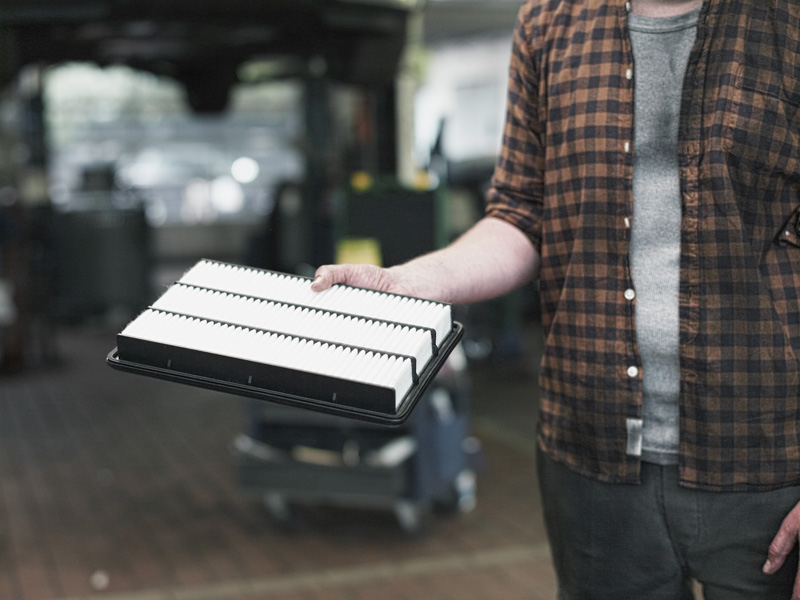
Damage to seals, end caps, and bonding
High-pressure air jets can harm non-media components:
- Gasket/seal nicks or lifting causing bypass leakage (unfiltered/dirty air around the filter leaking into the engine).
- End-cap adhesive cracks or separation.
- Distortion (panel filters) or cartridge filter end-cap loosening.
The result? Even with intact media, you can get dirty air bypassing directly into the engine, which is often more harmful than bypass through damaged media.
Downstream contamination
When you blow from the dirty side (or the clean side without containment), you can aerosolise dust:
- Dust can settle on the clean side of the housing or intake ducts.
- On restart, that dust can be ingested downstream.
- In engines, this can accelerate wear on turbo compressor wheels, cylinders and piston rings.
The result? A “cleaning” step can become a contamination event.
With other known issues (problems with engine sensors and turbochargers for example) and the health risk to the mechanic of rapidly dispelled fine dust (eye damage, breathing-in of harmful substances), is it worth saving a few pounds or minutes by taking the cheap option? Change your air filter, don’t try and clean it! Your engine will thank you.