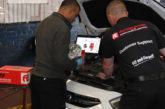

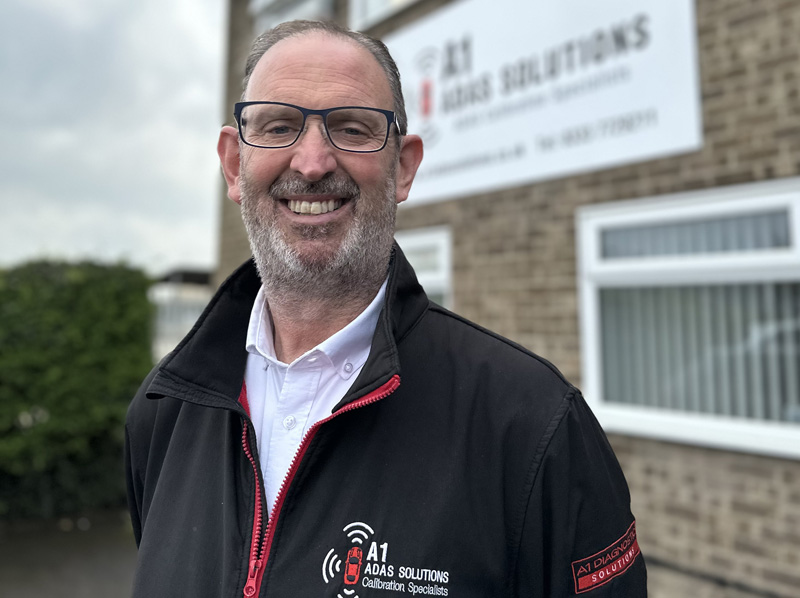
As the head of a business that supports workshops with ADAS and calibration services, we thought Iain Molloy, managing director at A1 ADAS Group, was best placed to answer whether it’s now time to add ADAS checks to the MOT. So here he is, in his own words.
Before we even get to the MOT question, it’s worth acknowledging how central ADAS has become to modern vehicle safety. Features like AEB, blind spot detection systems and driver monitoring are now preventing real-world collisions, not just in theory, but in practice. Many drivers say their ADAS has stepped in to avoid an impact.
And yet, as someone who oversees these systems daily, I know the safety benefit only exists when ADAS is functioning correctly. ADAS can be significantly out of calibration with no warning light at all, which means the driver has no idea their AEB or lane assist may not intervene when needed. When you combine that with the fact that the car parc is rapidly shifting towards ADAS-equipped vehicles, it becomes clear why the MOT is being pulled into this conversation. If roadworthiness is about ensuring a vehicle can operate safely, how long can we ignore the systems responsible for preventing a large percentage of avoidable accidents?
Not so easily done
Although the safety case is strong, the practical implementation is far from simple. The first barrier is physical space. Correct ADAS calibration requires a level floor, controlled lighting and specific distances for targets. Many MOT stations simply don’t have the footprint.
The second barrier is knowledge. Only a small proportion of technicians currently hold ADAS qualifications, yet demand is rising fast. If the MOT suddenly created an additional compliance requirement, the skills shortage would widen.
The third barrier is that ADAS doesn’t behave like traditional MOT items. A visual walkaround tells you almost nothing. A warning lamp might come on, but only when the system is seriously compromised. Subtle misalignment can leave a vehicle looking healthy on the dashboard but dangerously underperforming on the road. That is not the kind of fault an MOT bay can reliably detect.
Invisible to the eye
If ADAS faults were as simple as a lamp test, the MOT could adopt them overnight. But most aren’t. Slight sensor misalignment can add metres to a braking intervention, yet show nothing to the driver. That’s where I worry. A pass certificate gives motorists confidence that everything important has been checked. But right now, the MOT doesn’t touch the systems that dictate how a modern vehicle avoids danger. At the same time, drivers may already assume ADAS is tested during the MOT, or believe their car doesn’t have ADAS at all.
The knowledge gap isn’t just in the trade. Forty per cent of buyers say they were never given any explanation of their ADAS at the point of sale. Bringing ADAS into the MOT could accelerate public understanding, but it also means MOT stations will be the ones fielding the questions.
Some resistance is inevitable. From motorists, because anything that risks raising the MOT price is unpopular. From workshops, because ADAS investment isn’t cheap and the training curve is steep. But we shouldn’t confuse resistance with reason to do nothing. ADAS is no longer optional luxury tech. It is a core safety system. As more vehicles rely on these features, ignoring them in the MOT becomes harder to justify.
What might a realistic MOT approach look like? I don’t pretend to have the answer, but certain principles make sense if we want a solution that’s practical and genuinely improves safety:
Status and warning-lamp checks inside the MOT
This is achievable now. If a vehicle shows a critical ADAS fault, it should be recorded and ultimately become part of the fail criteria.
Visual inspection that focuses on risk, not box ticking
Checking for damaged or displaced sensors is useful, but it shouldn’t be seen as an assessment of system performance.
Calibration carried out outside the MOT at a specialist centre
This is the crucial part. Regular ADAS calibration must be mandated somewhere, but it can’t realistically be done inside MOT bays. Calibration should be completed in workshops with the correct equipment, conditions, and by IMI-qualified ADAS technicians. MOT stations would simply verify that a valid calibration record exists. A national database could make this workable and provide traceability.
Clear rules on which vehicles fall into scope
Not every car has ADAS, and not every earlier generation system is critical. A logical cut-off would be from around 2022, the point at which basic ADAS became mandatory on new vehicles.
Are we even ready?
Any MOT reform involving ADAS will only succeed if the workforce is ready. The industry knows this. Most workshops say they plan to increase spending on ADAS training and equipment, yet we are still far below the number of qualified technicians needed for the next decade. Government support may be required, whether through grants or incentives for investment. Without it, smaller MOT stations could struggle.
So, should ADAS be included in the MOT? Yes, I believe so – but only if the approach is meaningful. A tick box exercise does nothing for safety.
ADAS calibration checks can’t be performed during a standard MOT, yet ADAS status absolutely should be part of the roadworthiness conversation. The MOT can verify faults and check calibration evidence, but it can’t replace a calibration assessment.
What matters now is that we start asking the right questions. How do we enforce calibration without overwhelming the industry? How do we educate motorists so they understand why ADAS matters? And how do we make sure any new MOT requirement genuinely improves safety rather than adding administrative noise?
One thing is clear. Doing nothing is no longer an option. ADAS must have a place in the UK’s roadworthiness framework, and the sooner we shape a practical and proportionate solution, the safer our roads will be.

![Bosch’s ESI[tronic] diagnostic software](https://pmmonline.co.uk/wp-content/uploads/2026/03/Febi-diagnostics-tool-165x109.jpg)