2025 was another year of change in an increasingly complex oils and lubricants market, as VLS Chairman Darren Frogson explains to PMM.
Not quite an ‘annus horribilis’, but 2025 certainly posed continued challenges for the automotive aftermarket, and particularly for engine oils and lubricants. These essential components of modern vehicles play a vital role in delivering fuel economy gains and emissions. But with more OEM-specific specifications, combined with an increasingly diverse and ageing vehicle parc, engine oil selection for mechanics is more difficult than ever.
Add to that cost pressures, with a static MOT fee and ongoing inflation affecting labour and parts, and it might feel like a perfect storm. Many workshops are looking to save costs where they can, while motorists are increasingly reticent to spend on anything but essential, minimum vehicle maintenance.
At the independent membership body VLS, the Verification of Lubricant Specifications, we have worked hard over the year to uphold standards in this increasingly complex industry, so that end users can have confidence that the products they select for use in customer vehicles are fit for purpose and deliver what they claim.
Last year, we opened 16 new cases, investigating complaints about a range of passenger vehicle and heavy-duty vehicle engine oils, including 0W-20s, a 0W-30, and several 5W-30s. Every single one of those cases has been related to conflicting or unevidenced OEM approvals, and in some cases, non-compliance with ACEA specifications and low temperature properties as well. Some of the cases have been resolved; however, most remain under investigation.
Market trends have prompted some of these cases.
In October, VLS launched a widespread market investigation and issued a caution over engine oils making claims against the Stellantis FPW 9.55535/03 specification, used by vehicles including Peugeot, Citroën, DS, Fiat, Vauxhall and Opel models.
The specification was initially launched in July 2023 and revised in June 2024. Four products have been approved against the 2023 specification and have until June 2026 to be re-approved against the 2024 revision. However, our research identified more than twenty other brands making product claims against this specification.
VLS believed that the technology to support this specification was not yet widely available to the general market. Industry experts were concerned that claims to meet the specification might be being made without the support of the additive company or technology provider, or in the absence of the supporting technical performance data to demonstrate that the formulation can meet the specification. VLS has already proactively contacted several companies to request evidence to support their product claims against the specification, and the technical review panel is considering their responses.
Real consequences
This isn’t just a matter of technicality. It really matters. Using oils that fail to meet the requirements of the intended specifications can cause accelerated wear to engines, reduce the effectiveness of emission control systems, invalidate warranties, and ultimately result in long term engine damage and unhappy customers. All of which could have been avoided. Mechanics and vehicle owners must be able to have confidence in the lubricant products used in their vehicles.
During the year, VLS issued two safety warnings relating to brake fluid and hydraulic fluid, as well as escalated these and an engine oil case for action, after the company involved failed to take sufficient action during the VLS investigation process.
Untested additives were another market development causing concern.
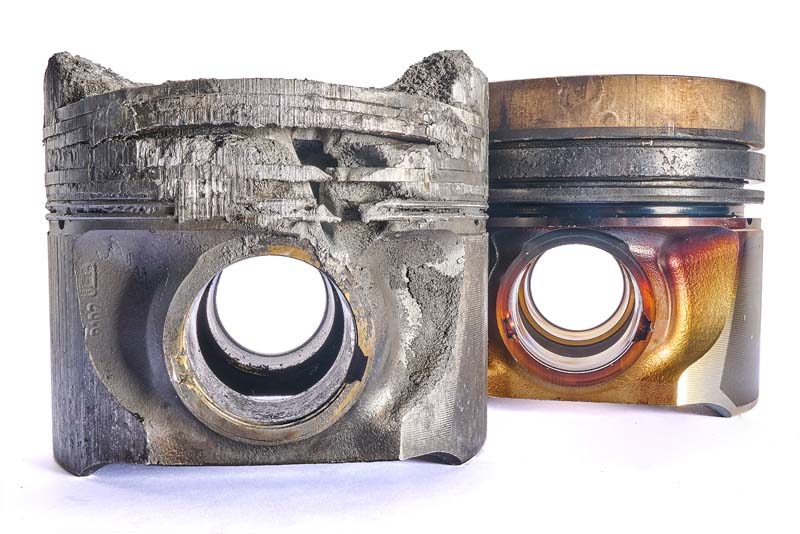
During the year, experts at Lubrizol, a major global organisation supplying additive technology to lubricant blenders, published an article on the real-world performance gap between some engine oils labelled ‘Suitable for Use’ (SFU) and fully OEM-approved products (see pictures).
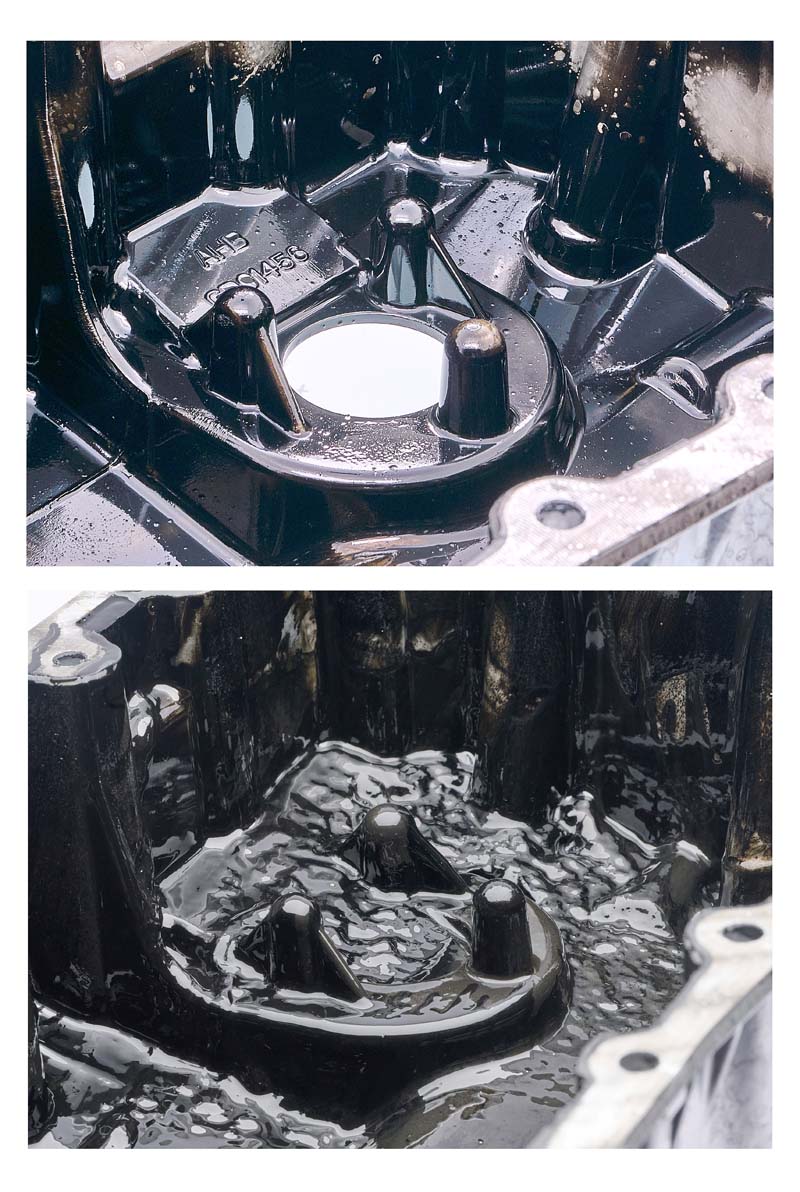
Scientific testing uncovered several issues with the SFU oils tested, including piston failure, significant increases in viscosity, enough to impact the oil’s ability to circulate efficiently within the engine, inadequate oil flow at low temperatures, a higher risk of sludge buildup, and seal degradation. In an extreme case, Lubrizol witnessed catastrophic engine failure as a direct result of a low performance SFU oil.
At VLS, we recognise that SFU oils can be excellent quality products and meet the requirements of OEM specifications. However, like any marketing claim, marketers must be able to support it with valid technical data.
The concern is that some products may be using untested additive packs, a market development that VLS has been following closely over the past twelve months. VLS, in conjunction with our European partners at SAIL/ATIEL and UEIL, recently published Additive Pack Guidance. The guidance clearly states the difference between tested and untested additive packs and that, regardless of the additive pack type, the lubricant marketer holds full legal responsibility for all product performance claims.
Additive suppliers are not legally responsible for the quality or performance of the final lubricant. While additive companies are responsible for providing available performance test data, the ultimate accountability remains with the marketer. If the additive supplier cannot supply adequate validation data, the blender and/or marketer must conduct their own testing to substantiate any performance claims. Depending on the performance specifications claimed, this could require extensive performance testing, likely to cost in excess of a million US dollars per product. Lubricant marketers must ensure their claims are fully supported by credible, comprehensive technical data, which can be provided on request.
As we look ahead to 2026, I am delighted to be leading VLS over the next 12 months, having become Chairman at the end of September. A VLS Board member since 2015, I am passionate about our independent organisation’s work to maintain a fair and open lubricants market that benefits end users by assuring the performance claims made on lubricant products are valid and reliable.
In my time as Chairman, I am keen to support VLS members and the wider lubricants industry through the transition to net zero, with its increasingly complex vehicle parc, and to maintain VLS’s track record in managing non-compliance and supporting end users. As we start 2026, just four years remain until the sale of new purely internal combustion engine (ICE) cars will be banned by the UK government, and just nine years remain for full and plug-in hybrid vehicles to be sold, which have become such a popular choice for new vehicle registrations. More change is to come.

![Bosch’s ESI[tronic] diagnostic software](https://pmmonline.co.uk/wp-content/uploads/2026/03/Febi-diagnostics-tool-165x109.jpg)