Rotronics CEO Ken Clark offers his expertise on the 12V battery and reminds workshops that they’re just as important on EVs as on ICE vehicles.
Every vehicle on the road today, whether it runs on petrol, diesel or electricity, depends on a 12-volt battery to function. It’s easy to overlook, especially in the EV era, when so much attention is focused on the high-voltage traction battery. But the 12V auxiliary battery remains just as critical, and neglecting its testing and charging is one of the most common and preventable causes of vehicle downtime, and one of the most overlooked revenue opportunities sitting on a workshop’s doorstep.
In a traditional ICE vehicle, the 12V battery’s defining job is cranking the engine, alongside powering lighting, control modules and infotainment. If it can’t crank the engine, the vehicle won’t start, which makes battery health easy to judge with a simple cranking amps (CCA) check.
From flooded to AGM
Flooded lead-acid batteries were the standard for decades, but stop-start technology exposed their weaknesses. An AGM battery can deliver around 60,000 engine starts, roughly three times a flooded battery’s life, which is why fitting a flooded battery to a stop-start vehicle usually fails within 12 to 18 months. AGM batteries need higher, more tightly controlled charging (typically 14.4 to 14.8V absorption versus 13.8 to 14.4V for flooded) and conductance testing rather than simple voltage checks. Charging an AGM battery on flooded settings is now one of the most common causes of premature 12V failure in modern ICE vehicles.
EVs change the equation
There is no starter motor and no cranking load. Instead, the 12V battery wakes the vehicle, initialises its systems, closes the high-voltage contactors, and enables module communication and charging. If it fails, the vehicle won’t work, regardless of how much charge sits in the traction battery. A weak EV auxiliary battery rarely shows an obvious symptom like a slow crank; instead it appears as module dropouts, failed wake-ups, charging faults or dashboard warnings that look nothing like a battery problem.
A charged battery is not enough
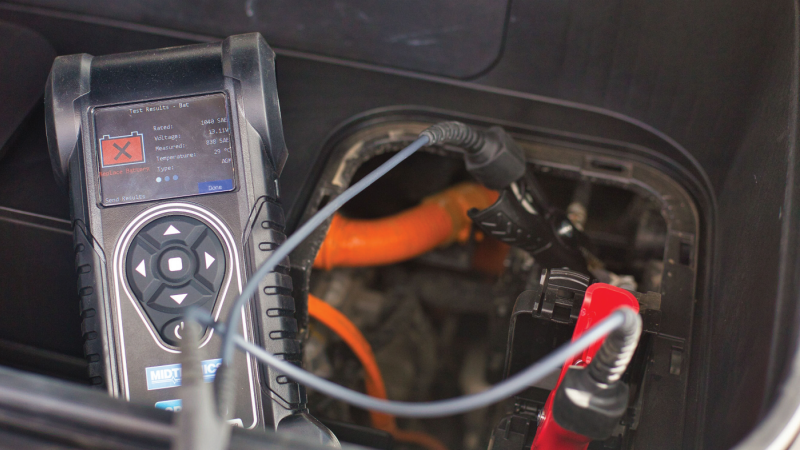
High-voltage and low-voltage systems are completely separate. A vehicle with a weak 12V battery may fail to unlock, refuse to communicate with diagnostic equipment, or simply refuse to charge, all while displaying warnings that seem unrelated to the battery. Without accurate 12V testing as a first step, technicians can waste hours chasing phantom high-voltage faults when the real cause is a simple low-voltage problem. ICE and hybrid batteries are judged on Cold Cranking Amps; EV auxiliary batteries depend on Reserve Capacity (RC), their ability to sustain longer bursts of power for system startup, safety relays and accessory loads. Testing them requires specialist equipment; conductance testing alone is no longer sufficient.
Why regular testing matters
Regular, scheduled testing catches degradation before it becomes a breakdown. A battery weakening under sustained electronic load won’t necessarily fail a basic voltage check, but may already be heading toward wake-up failures or contactor faults. Building 12V testing into routine servicing is the single most effective way to avoid downtime, warranty comebacks and misdiagnosed high-voltage complaints.
Workshops need tools built for this different load profile. The Midtronics CXP900/ROBIS handheld tester and DCA8000 diagnostic platform are designed for EV 12V auxiliary battery testing and charging. For traction battery testing, charging and module balancing, the Midtronics xMB-9640 Aftermarket is required, reflecting how distinct these two disciplines have become.

The ROI of testing every vehicle
This is where the Rotronics Battery Management Programme pays for itself. Rotronics data shows that for every 100 vehicles tested, 30 per cent need no further action, 30 per cent need charging, and 40 per cent are at risk of failure and need replacement.
Putting a price against that, at an average battery replacement value of around £100, and a charging service priced at £5 to £10. Testing 100 vehicles delivers roughly £4,150 to £4,300 in additional, immediately billable work, that would otherwise leave your workshop unnoticed and undiagnosed. That is an average of over £40 of incremental revenue per vehicle tested, from a test that takes minutes and needs no extra marketing spend, no extra footfall and no extra technician headcount. It simply captures revenue that is already driving through your door.
The return compounds beyond the invoice, too. Catching a failing battery before it strands a customer avoids costly comebacks, protects your warranty position, and builds the trust that keeps customers coming back and referring others, value that doesn’t show up in the initial calculation but shows up in retention.
The core message is simple: if the 12V battery fails, the vehicle fails with it, no matter how much charge sits in the traction pack. Regular testing and correct charging of the auxiliary battery aren’t optional extras; they are essential maintenance tasks that prevent misdiagnosis, reduce downtime, and open a genuine, low-effort revenue stream for your workshop.
Not every workshop is ready to tackle EV module balancing or replacement, but every workshop can add a 12V auxiliary battery check to its maintenance routine and start capturing the revenue it’s currently leaving on the table.