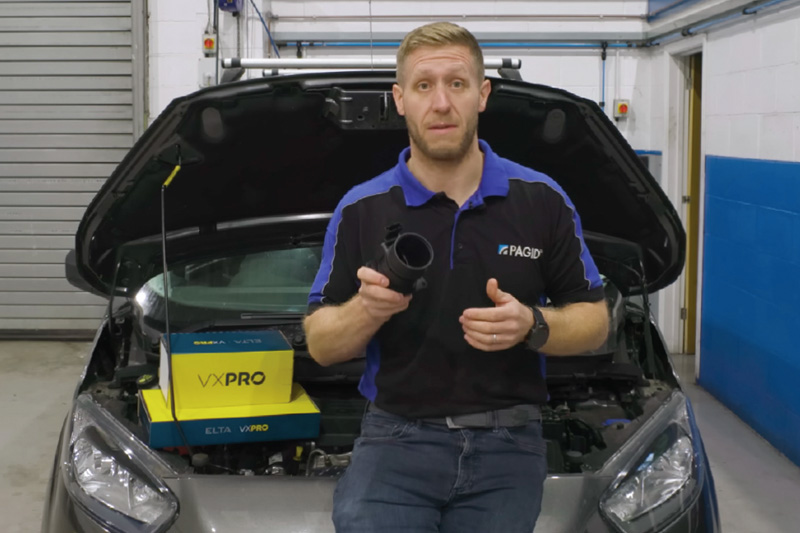
Edd from Uckfield Motor Services looks at some best practice advice when it comes to mass air flow sensors with Elta Automotive.
So mass air flow sensors basically do what it says on a tin. They detect the amount of air that’s taken in through the intake and that’s going into the engine at any one time. There are two types: hot wire and hot film.
Hot wire is generally on older vehicles, hot film on the newer. They both detect the amount of air going past. It cools down the sensor and then it sends a signal back to the engine ECU to tell the ECU how much air is going into that engine so it can inject the right amount of petrol and diesel.
They do get a little bit more complicated than that, especially on modern vehicles because they’re used for detecting if some of the EGRs are opening and closing and even down to something like a DPF blocked. We’ve had cases where a DPF’s been blocked and it throws a air mass sensor off because obviously it can’t push the right amount of air through the engine.
So there are a lot of things that the mass air flow sensor data is used for and to keep the engine running exactly how it should be. We see a lot of new mass air flow sensors fitted to vehicles just because a fault code is thrown up. But it might be something else that’s causing that mass air flow sensor fault code to come up: It might be too high, too low because there’s not enough air going through the system.
So something I’ve banged on about in previous videos is a good diagnosis. It’s the first thing you need to get right before putting any part on a car. And one of the most misdiagnosed things we see is mass air flow sensors.
First things first, you need to get the symptoms from the customers. You need to get a good description from them. Then the next thing is a fault code read, but that’s not the be all and end all.
Probably 90 per cent of the time it’s not a mass air flow sensor issue. It’s something else causing it to also flag that fault code. So first thing’s first, I would check for air leaks. Smoke detectors are a brilliant bit of kit. They can show pretty much any air leak on a vehicle when used correctly. Next thing is just looking at the live data. Is the EGR open and closing correctly when it’s meant to. Is the DPF filled up? Is there something else you’re missing on the vehicle? Check the general state of the engine because it is a car that hasn’t been serviced that much and it’s full of carbon and horrible and it’s horrible like that, it may well be flagging out the mass air flow sensor.
You can also scope the sensor, make sure it’s working correctly. So, there’s plenty of stuff you can do before just throwing a new sensor at it. Another great example is always, as I said, check the servicing of the vehicle because we’ve had plenty of air flow sensors fault codes thrown up because of blocked air filters. And even on some of Mercedes, you actually have to reset an air filter service code inside the diagnostic platform to let it know that the air filter has been changed. So, make sure you check that.
We’ve been fitting Elta’s products for many years. They’re a British brand which is always nice these days. A lot of their stuff comes with a 5 year no quibble warranty. And what I love about it is we’ve had no problems with fitment, their technical support is really good as well. I would really recommend just choosing a product that you can really trust and you know is goingto sort the problem out on the car, right?