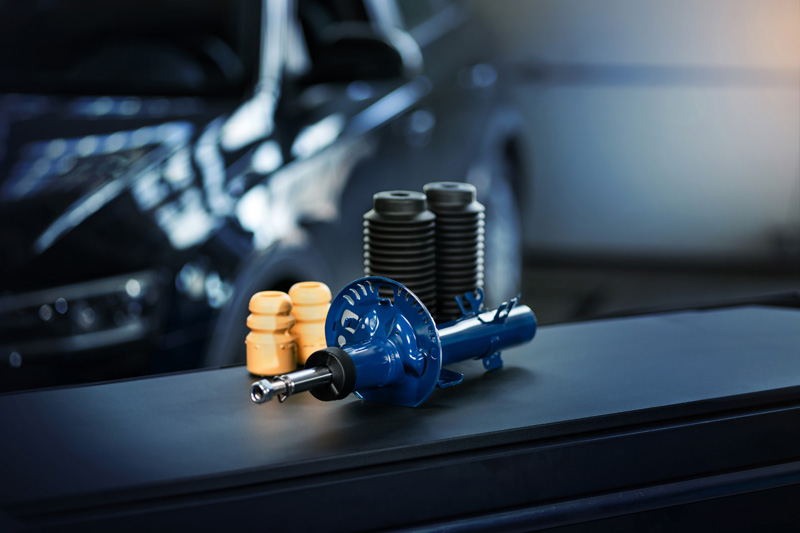
German aftermarket supplier Meyle outlines the importance of technical expertise in replacing shock absorbers, as well as providing some EV specific tips.
Shock absorbers are a safety component installed in every vehicle and have an impact not only on driving stability and comfort, but also on the wear and tear of other suspension components.
At the same time, the suspension is undergoing a continuous change, with the trend moving from traditional shock absorbers with conventional properties to adaptive and active dampers. With newer vehicles in particular, workshops face higher demands in terms of diagnostics and technical expertise. Meyle, spare parts manufacturer based in Hamburg, explains what matters most when it comes to modern shock absorbers, how electric vehicles are different in that regard, and how workshops can benefit from practical spare parts and targeted training courses.
Engineering principles:
Function and mode of operation
Taking a look at the engineering principles behind modern damping systems will provide a better understanding of these developments. Shock absorbers transform kinetic energy into heat and control vehicle body motion to absorb vertical movements and vibrations.
Hydraulic valves, pistons and oil-ways regulate volume flow and generate damping force proportional to piston speed.
Different variants:
- Passive dampers offer fixed properties and are factory-set for comfort or sporty behaviour.
- Adaptive dampers adapt their properties with electrically controlled valves or magnetorheological fluids. As a result, workshops need to include electronic control systems in the troubleshooting process, making diagnostics and testing all the more complex.
- Active systems generate or control forces actively and regulate damping and vehicle height.
Modern systems use sensors (e.g. suspension travel, acceleration, steering angle) and electronic control units to continuously optimise damping.
Tesla Model 3, for example, features adaptive damping technology – a hydraulic system that responds softly to low frequencies and firmly to high frequencies – resulting in driving behaviour with greater comfort and handling precision.
But systems like this have high demands in terms of spare part quality and installation precision. As a result, workshops need to take electronic control systems into account, making diagnostics and testing even more complex.
Typical faults and diagnostics at the workshop
Common issues:
- Leaks or damp damper housing
- Noises/excessive play due to elongated bearings or bushings
- Loss of damping –vehicle sways
- Inconsistent damping on the left and right side
- Corrosion or wear at the piston rod
- ‘Fading’ due to thermal overload
Diagnostic methods:
- Visual inspection: checking for traces of oil, rust, damage
- Manual inspection: damper removal and inspection – consistent resistance in compression and rebound
- Test drive: observing oscillation on uneven surfaces
- Test bench: comparison of force-displacement curves
- Symmetry comparison: right with left or old with new part
- Inspection of adjacent components: inspection of components like control arms and bearings for damage
Tesla Model 3
Replacement is the same for both electric and combustion engine vehicles when it comes to shock absorbers. In Germany, this requires, at the very least, Qualification level S1 (skilled persons to work on non-live HV systems) with a S2 qualified person employed in the workshop in accordance with DGUV Information 209-093.
According to the Tesla service manual, there’s no need to replace both shock absorbers unless explicitly called for by a service bulletin. However, Meyle recommends replacing both every time to prevent inconsistent oscillation behaviour and suspension on the left and right side.
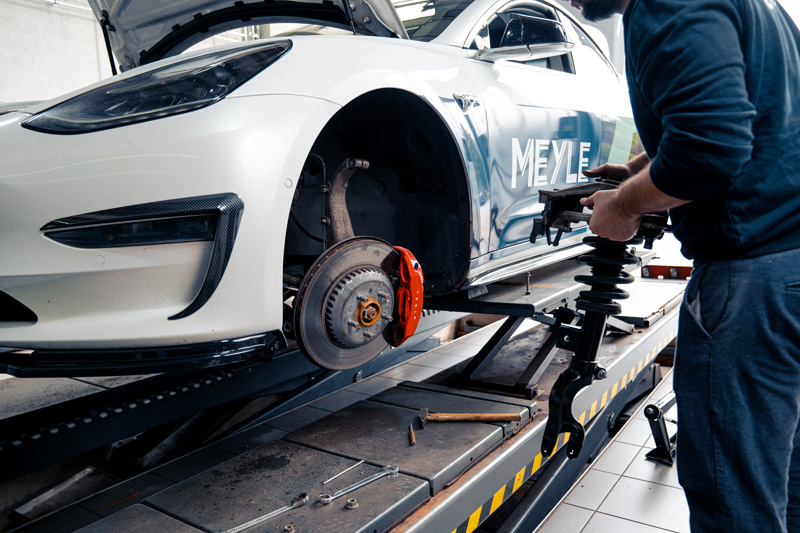
‘It’s also essential to observe the tightening torques specified in the data sheet and, if necessary, replace the original bolts. And the damper bushings also need to be properly aligned,’ emphasises Thorsten Rafalzik, Meyle shock absorber specialist.
After the installation, the vehicle needs to be lowered and bounced up and down several times as usual.
Calibration and wheel alignment:
Electronic calibration is not necessary for the Tesla Model 3, as the dampers are purely hydraulic. However, wheel alignment is required for maintaining the prescribed alignment values after any suspension work.
Tesla-specific features:
The new MEYLE shock absorbers for Tesla Model 3 feature a customised design that accelerates installation, reduces working time and increases profitability for the workshop.
The shock absorbers come as a pair in a practical set, including installation materials and an oval socket wrench for accelerated installation.
In addition, the innovative C-shape design of the front shock absorbers are designed to be easily inserted from the side, unlike OE shock absorbers, which have to be pulled over the narrow drive shaft.
In addition to simple, time-saving installation, the new Meyle shock absorbers also offer clever technical benefits and high efficiency. For example, optimised damping properties ensure a comfortable driving experience and keep the car stable even at high speeds, whilst the 16mm piston rod maximises durability even in demanding driving conditions. To fulfil the specific requirements of electric vehicles, the shock absorbers also feature a corrosion-resistant cathodic dip coating. In addition, a special oil fill ensures damping performance even at low temperatures – for example, in the winter.
Meyle aims to play an active role in helping workshops respond to the challenges of the technological transformation – for example, with customised training courses on modern damping systems and single- and multi-day training courses specifically for Tesla vehicles.
Opportunity for independents
The suspension continues to evolve and grow more intelligent through the use of components like sensors, which makes it even more important for workshops to prepare for these technologies – with targeted, practical training courses on modern damping systems as well as high-quality spare parts.
Spare parts manufacturers like Meyle offer modular, easy-to-install solutions that not only save time and resources, but also greatly simplify everyday workshop operations.
After all, investing in expertise, equipment and training at an early stage will allow companies to remain competitive in the era of electric mobility.