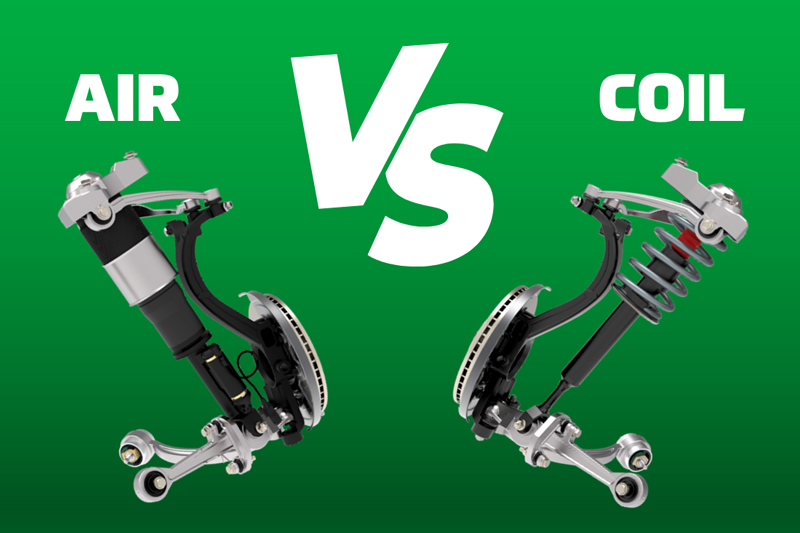
Experts in all things suspension-related, Arnott walks readers of PMM through the various features of coil and air suspension systems.
A suspension system plays a crucial role in how a car feels, handles, and behaves on the road. It is not only responsible for absorbing bumps and road imperfections, but also for controlling body movement during acceleration, braking, and cornering. In essence, the suspension defines the connection between the car and the road surface, directly influencing safety, comfort, and handling.
While coil springs continue to be the standard equipment in most passenger cars, air suspension that was once reserved for luxury vehicles has steadily expanded into mid-range models. Both systems offer unique advantages. Understanding how they differ helps drivers choose the setup that best matches their driving habits, needs, and expectations for comfort and handling.
How suspension “shapes the ride”
At the core of any suspension system is the spring rate, which is the amount of force required to compress a spring. The spring rate strongly influences how a car balances comfort with stability. A higher spring rate indicates a stiffer spring. Stiffer springs reduce body movement during cornering, braking, and acceleration, providing a more controlled, performance-oriented feel. However, the trade-off is that they transmit more of the road’s texture into the cabin, which can make the ride feel firm or even harsh on uneven surfaces.
A lower spring rate produces a softer spring that compresses more easily. Softer springs allow the suspension to absorb bumps and irregularities smoothly, improving comfort and making the ride feel more relaxed. However, they may also allow more body roll and pitch, which can reduce stability during aggressive driving and lead to greater compression in the rear suspension under heavy loads.
Traditional coil springs operate with a fixed spring rate, which means a compromise between comfort and handling is inevitable. As a result, the suspension is typically tuned to work reasonably well across a wide range of conditions rather than optimised for any specific situation.
Air springs behave differently. Their effective spring rate is not fixed by nature; it changes depending on the air pressure in relation to the volume. When an air spring is compressed, the volume reduces, thus the pressure will increase automatically. This adaptability allows the suspension to respond to varying loads or driving conditions in a more comfortable way.
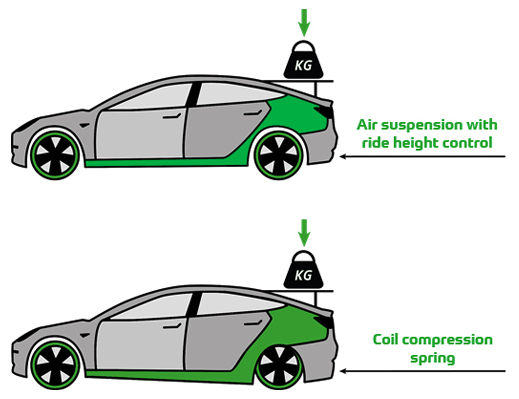
For example, when a vehicle is heavily loaded with passengers and luggage, the system will increase air pressure to obtain the same height level. This results in a higher spring rate to maintain consistent body motion, ensuring stability without sacrificing comfort. Secondly, the system preserves effective suspension travel and ride comfort under load. This creates what is often referred to as a load-independent ride.
With a coil spring setup, added weight may soften body movements, but reduced suspension travel under load increases the risk of bottoming out.
Ride height and load levelling
Maintaining a steady ride height is another important aspect of air suspension’s unique benefits. Vehicles with coil springs will gradually sag when a load is added. This reduces the remaining suspension travel, increasing the likelihood of bottoming out on rough or uneven roads. Secondly, it will also influence the wheel alignment, increase (uneven) tire wear, and impact handling in terms of road grip and road grip. On roads that are rutted, grooved, or otherwise irregular, this can make the vehicle feel less stable and responsive, and can cause a vague steering feel.
Air suspension addresses this issue through the use of ride height sensors. These sensors continuously monitor the vehicle’s position and automatically adjust air pressure in the springs to maintain the proper ride height. Regardless of how many passengers or how much cargo the vehicle carries, the suspension travel and handling remain consistent.
Comfort
One of the most recognised benefits of air suspension is its ability to isolate passengers from road imperfections. Because air compresses gradually and progressively, it absorbs bumps and vibrations more effectively than most coil springs. The result is a smoother, more cushioned ride. Drivers often describe this quality as the most significant advantage of vehicles equipped with air suspension.
Coil springs can also offer a comfortable ride, especially when carefully tuned. However, even well-designed coil setups typically transmit more of the road imperfections into the cabin, particularly when encountering sharp bumps or uneven surfaces. In practice, this means that while coil springs are perfectly adequate for daily driving, air suspension tends to excel in providing consistent comfort over varied road conditions and is therefore less tiring when driving longer distances.
Another advantage of most air suspension systems is the ability to lower the vehicle at higher speeds. Bringing the chassis closer to the surface decreases aerodynamic drag, subtly improving fuel efficiency on highways or motorways.
Durability, complexity, and maintenance
Coil-spring suspensions are praised for their simplicity and durability. Their design is straightforward, with fewer components. This makes repairs easier and lowers the cost of ownership over the vehicle’s lifetime. For this reason, some vehicle owners choose to replace a failing air suspension system with a traditional coil conversion kit, especially when the cost of repairs is no longer proportionate to the vehicle’s residual value.
Air suspension systems offer adaptability and load-independent comfort but come with added complexity. Next to the air struts and air springs, they involve additional system components, including level sensors, an air compressor, an electronic control unit, wiring, and air lines.
Modern air suspension systems are engineered to be highly reliable, but like any advanced technology, these parts benefit from regular maintenance checks as components like air sleeves are subject to wear and need replacement eventually.
Making a choice
Ultimately, both systems emphasise different qualities: an air suspension setup offers greater refinement at a higher cost, while coil suspension provides a more traditional feel and lower ownership expense.
Coil springs suit drivers who value simplicity and durability. They perform consistently and are easier to maintain, though comfort and adaptability can be limited under heavy loads or varying conditions.
In contrast, air suspension appeals to those who prioritize comfort without sacrificing handling, who value constant adaptability, and desire consistent performance despite the road conditions. Its ability to maintain ride height, absorb bumps effectively, and adjust to load changes provides a smooth and controlled driving experience.
As vehicle expectations evolve, the demands on suspension systems are changing as well. Modern vehicles are generally becoming heavier, as today’s drivers expect more in terms of comfort, safety, infotainment, and advanced driver-assistance systems (ADAS). Additionally, popular segments such as SUVs, with their higher centre of gravity, and electric vehicles, which carry heavy battery packs, are encouraging manufacturers to consider air suspension over coil springs due to the benefits it provides.