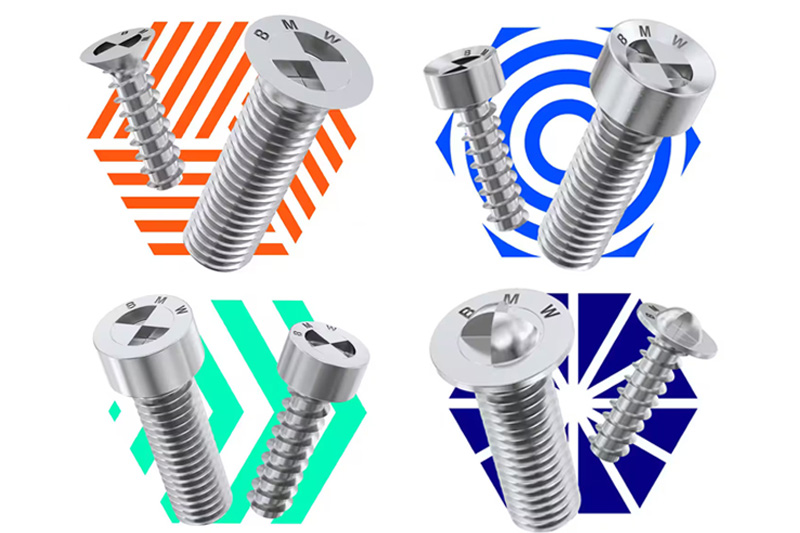
The experts at Accu, a leading provider of reliable engineering and precision components, have analysed BMW’s patent (DE469242297), which covers three head styles: cap head, countersunk and flanged button head. Additionally, automotive expert Richard Rackham, former Head of Concept at Lotus Cars, weighs in on what this means for mechanics, manufacturers and owners. Here’s what happens when branding collides with the wrench.
The automotive fastener industry has evolved strategically over the past century: from slotted and Phillips heads for low-torque applications to hex socket and Torx designs that handle high torque efficiently. Thread forms were standardised to ISO metrics, and the industry aligned around drives with proven performance and ubiquitous tooling.
The BMW design disrupts this. Where Torx distributes torque across six contact points, the BMW fastener concentrates force into two opposing quadrants.
“Two parallel faces for a drive is by no means novel, but few other brands have used their logos as a usable feature in a design such as this,” observes Patrick Faulkner, lead engineer at Accu. “The shaped recesses should naturally lead to positive engagement, but as someone who occasionally has to work on vehicles, non-standard fasteners are a pain to encounter.”
Here are some of the engineering trade-offs that come with this new design:
Performance: With only two engagement points, the design risks cam-out if not perfectly aligned. To achieve equivalent torque without shearing, the head likely needs to be physically larger than comparable Torx fasteners. In EV design where every gram affects range, thousands of heavier fasteners matter.
Access: The drive is strictly axial; it must be approached from directly above. Unlike hex bolts accessible from multiple angles, this creates challenges in tight spaces behind dash panels or cramped engine bays.
Cost: Bespoke production tooling and unique service tools add expense throughout the supply chain, while established drives benefit from standardised, ubiquitous infrastructure.
Faulkner comments: “The fact that they have taken so much care in creating a design with visual interest, I imagine it will more likely be used in environments where the user will see it, such as trim pieces, interiors or decorative elements.”
Security theatre and market reality
“This patent acts as a physical firewall around the component, challenging the ‘Right to Repair’ movement,” notes Alastair Morris, managing director at Accu (UK). “But if history has taught us anything, looking at the Apple pentalobe for one, it’s that the aftermarket views these barriers as puzzles to be solved, not permanent stops. Accessibility usually wins in the end.”
History proves the point: Apple’s pentalobe, Nintendo’s gamebit and security Torx were all exclusive until aftermarket manufacturers reverse-engineered them. With modern 3D scanning and CNC machining, “BMW compatible” bits can be manufactured within weeks. While BMW can patent the screw, preventing global tool sales is far harder.
For independent workshops, initial frustration with proprietary tooling creates market opportunity. Reverse-engineered drivers will emerge, and for vehicles outside warranty where BMW fasteners prove troublesome, mechanics may simply replace them with conventional alternatives, except where the visible logo adds aesthetic value.
The industry perspective
Having spent much of his career focused on chassis design, Richard Rackham, automotive expert and former head of concept at Lotus Cars, offers a measured assessment:
“Commercially, it may pay off for BMW. It’s certainly a provocative concept that will attract discussion and good press. But in terms of practicality, it’s a retrograde step compared to industry norms like Pozidrive and Torx.”
“Once out of warranty, if the BMW fasteners have proven frustrating, the service network will simply replace them with conventional items, apart from when aesthetics are paramount,” Rackham predicts, before concluding: “They’re (BMW) already winning. It’s almost like a bit of vanity to further embellish their status whilst adding to the perceived value of the product to owners.”