
OSRAM has been addressing the confusion surrounding LED technology, especially when looking at MOT regulations.
There are two key categories of LED lighting in vehicles:
- Factory fitted LED units – these are sealed units with no replacement parts and are installed by the vehicle manufacturer and are fully road legal
- LED retrofit bulbs – these are aftermarket bulb replacements for headlight and auxiliary applications and are not road legal and are for off-road use only.
There is an extra confusion around this, as the MOT regulations allow for LEDs bulbs to be fitted in vehicles first registered before 1986 or on single source headlamp vehicles, such as motorcycles.
These distinctions are important when it comes to the topic of glare.
LED retrofit bulbs should not be confused with LED lights which are now the standard on many new vehicles. This LED technology has been homologated with the lamp unit as a single piece for which there is no replaceable part. This means motorists have seen the rise of LED technology and seen the benefits, but only when the car comes with LED headlamps as standard equipment at point of the vehicle being manufactured. There are LED bulbs from reputable manufacturers which can be fitted into a vehicle, however this is only for off road use, or as previously mentioned, in a vehicle manufacturers before April 1986. Fitting poor quality LED bulbs retrospectively into headlights which are not a sealed lamp unit, however, may result in misalignment, glare and can be dangerous, and this will impact other road users and may also damage the lamp unit.
In Europe, the majority of LED bulbs are either illegal or for off road use only. However, there are exceptions, in 2020 OSRAM launched NIGHT BREAKER LED, Germany’s first ‘street legal’ LED replacement bulb. OSRAM pioneered new LED technology that gained legal approval for specific headlights and vehicle types whereby each headlight model is individually tested to ensure proper light distribution on the road.
Since then across Europe, 28 countries have given approval to OSRAM’s NIGHT BREAKER LEDs, available for specific vehicle types, including Ireland. Yet in the UK, this approval has not been granted and the current MOT test does not allow it.
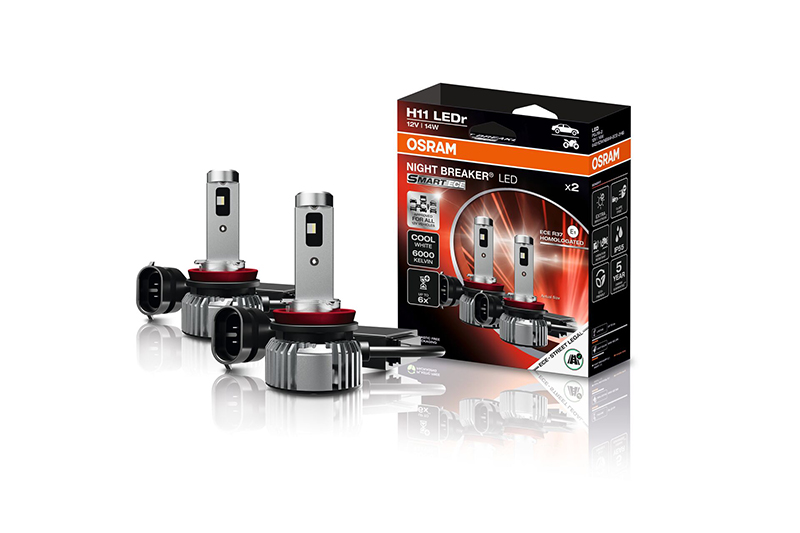
More recently, OSRAM introduced its NIGHT BREAKER LED SMART ‘ECE’ H11, the first fully ECE R37 homologated LED retrofit bulb, as well as the NIGHT BREAKER LED C5W ECE, the first ECE R37 approved LED auxiliary bulb.
The NIGHT BREAKER LED SMART ECE H11 is a product designed to upgrade bulbs and is approved for 12V vehicles in all ECE contracting states, which includes the EU and UK. It delivers a bright white light with a colour temperature of up to 6000 Kelvin. Its light output aims to ensure optimum visibility for the driver, while the glare seen by other road users is up to 50% less than the legally permissible maximum values. Compared to standard halogen bulbs, these LED retrofits consume up to 60% less energy and last up to six times longer, thanks to the LED technology and the specially developed vibration resistant design.
With the NIGHT BREAKER LED C5W ECE product, it too is approved for all 12V vehicles in all UN ECE member countries and offers a universal solution for all applications where a C5W bulb is specified. The LED solution fits a range of applications, from interior and reading lights to door and entry lighting through to side marker lights and license plate illumination.
With its cool white light of up to 6000 Kelvin, the C5W ECE offers up to 80% lower energy consumption, delivering an increase in efficiency, especially for fleets and vehicles with high electrical demand. In addition, the LED technology boasts a service life up to five times longer than traditional bulbs, reducing replacement effort and cost.
Because of these ECE markings, these bulbs should be legal in the UK, but unfortunately, is not yet the case. The ECE R37 approval marking on the bulb is a European standard sets performance requirements for vehicle lighting. This is enforced in the UK through existing regulations, such as the Road Vehicles Lighting Regulations 1989, which states that approved ECE R37 bulbs can be used in all headlamp units, as long as they are aligned correctly.
While the ECE R37 marking and Road Vehicles Lighting Regulations 1989 state these OSRAM ECE LED bulb are approved for use, the UK MOT test states:
4.1.4. Compliance with requirements – Existing halogen headlamp units on vehicles first used on or after 1 April 1986 must not be converted to be used with high intensity discharge (HID) or light emitting diode (LED) bulbs. If such a conversion has been done, you must fail the headlamp for light source and lamp not compatible.
As a result, if a NIGHT BREAKER LED SMART ECE H11 were to be fitted in a headlamp application, it is likely to fail the MOT. However, OSRAM is working with the Department for Transport to allow the wording of the MOT to be changed to enable the fitment of LED bulbs that have been type approved according to UN ECE Regulation 37.
As it stands, although both the NIGHT BREAKER LED SMART ECE H11 and NIGHT BREAKER LED C5W ECE are theoretically street legal and allowed to be used on UK roads, the situation demonstrates the legislation has not kept pace with technology, therefore the legislation around MOTs needs to be updated.
Lighting Marketing Manager at OSRAM, Terri Clark, commented: “There has been a lot of conversation in the last couple of years and more recent months about the issue around glare and dazzling lights on the road, and the culprit has been pinned on LED bulbs. However, this is not the case.
“There is a lot of confusion around LED bulbs and the legalities surrounding them and ultimately the problem in the UK is that there are two laws that contradict each other. We have a complete range of LED bulbs in the market, that can be used in vehicles manufactured before 1 April 1986, in motorcycles and for off road use. However, although it should also be appropriate for every other applicable vehicle where H11 or C5W bulbs are used, due to the rules of the MOT, we cannot sell it for on-road vehicles because the test has not yet caught up with modern technology or with other laws in the UK.
“There is also the misconception that LED bulbs are responsible for headlight glare on the roads, however, the most common causes are due to inconsiderate drivers not dipping from high to low beam, misaligned bulbs, poor quality headlight and auxiliary bulbs or drivers fitting cheap, poor quality, illegal, non ECE approved LED bulbs to vehicles that are not designed for them.
“Ultimately, this subject is complex and contradictory, which is why we are urging the UK Government, as well as the DVSA, to look into the laws and regulations surrounding headlight bulbs and ensure they are updated and in keeping with modern vehicles, current technology and the safety needs of road users.”