David Valentyne, aftermarket sales manager discusses the new generation of environmentally sustainable engine oils.
Demand for products that combine high levels of performance with strong sustainability credentials is growing, both from industry and from vehicle owners. Fortunately, technological advancements made in recent years mean that premium lubricants can now be produced from used oil without compromising quality.
As part of this shift and its broader netzero ambition, TotalEnergies acquired Finnish company Tecoil in 2024 to accelerate the use of re-refined base oils (RRBOs) in its premium lubricant range. Tecoil operates a 50,000-tonne-per-year production facility and has developed a circular economy network for collecting used lubricants across Europe.
The integration of Tecoil will significantly enhance the use of RRBOs in high-end lubricants and help to develop the EV3R range.
What are RRBOs?
RRBOs are base oils made from used engine, hydraulic or industrial oils, which would otherwise be classified as hazardous waste. The “re-refining” process treats used motor oils to give them properties comparable to the best virgin base oils.
With around 40 million cars in the UK requiring engine oil, there is roughly 150-250 million litres of lubricant circulating on the roads today. Much of this oil is drained and collected during routine maintenance and can, in theory, be regenerated into new lubricants.
Historically, RRBOs were considered inferior to virgin base oils. But thanks to improved re-refining techniques, they now span not only Group I oils categories (used in older engines) but also in higher end Group II and Group III categories suitable for most modern vehicles.
Today, RRBOs are a credible, high performing alternative to virgin oils.
What’s driving the take up of RRBOs?
Waste oil management has been regulated in Europe and the UK for many years. While incineration was once common, recent legislation (such as the Waste Framework Directive) has shifted focus toward recycling – and circularity.
Currently, around 82 per cent of theoretically collectable waste oil across Europe is successfully collected, and 61 per cent of that is regenerated. This is a marker of the maturity of the modern RRBO market, but there is significant room for growth – with regenerated base oils representing approximately 8 per cent of annual base oil production in the EU.
Led by the GEIR (European Waste Oil Re-refining Industry Association), there have been discussions around whether specific targets should be set in Europe for waste oil collection and regeneration and this may spark further growth in the industry.
UK is committed to increase sustainability and circularity (the government recently set up a ‘Circular Economy Task Force’ for instance). With aftermarket businesses already required to comply with waste oil management legislation and an increasing number of carbon footprint and energy efficiency measures in place, RRBOs are set to become an increasingly important cleaner and greener solution for UK workshops.
Behind the scenes
The Tecoil facility in Hamima, Finland, is cutting edge. It uses the regeneration chemical process to remove contaminants, dirt, water and particulates from waste oil, followed by advanced treatments to produce high-quality base oils. Impressively, the entire process is fully powered by green hydrogen produced on site.
This regeneration process achieves a 12x saving on CO2 emissions compared to virgin oil refining and produces the highest quality API Group II/II+/III base oils. The process can be repeated indefinitely, creating a potential “closed loop” system for engine lubricants.
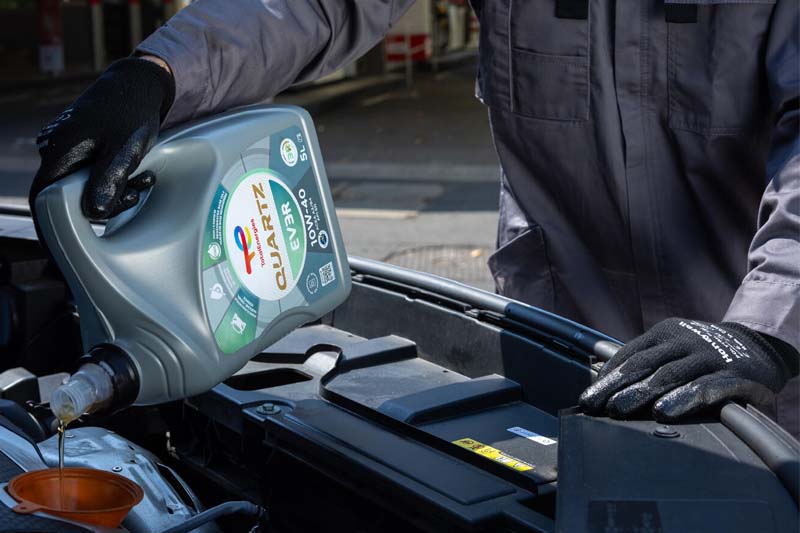
This has enabled TotalEnergies to bring to market the EV3R range. For example, Quartz EV3R (introduced in 2024) is Europe’s first engine lubricant made from 100 per cent premium regenerated base oils and supplied in 100 per cent recyclable containers.
It’s part of the SUSTAINera RECYCLE initiative by Stellantis (ex-PSA) and it’s approved compatible with Peugeot, Citroën, DS, Opel, Vauxhall, Renault and Volkswagen engines, while also meeting the technical requirements of Mercedes Benz specifications.
Quartz EV3R 10W-40 is a prime example of how modern RRBO technology is able to deliver superior performance that meets the needs of OEMs while providing sustainability benefits rights across the lubricant supply chain – from production through to ongoing maintenance.
With proven technology, growing regulatory support, customer demand and market innovations, RRBO lubricants have moved from niche to normal.